Molybdenum Electrodes in Electric Melting Furnaces: Three Misconceptions
WeiBeam · Electrode solutions for high-temperature melting
Three ideas about molybdenum electrode melting furnaces keep circulating: that the furnace is an arc furnace, that molybdenum conducts 1.3 times better than copper, and that it works above 3,000 °C. All three are wrong. This article checks each claim against published data, explains why the real heat source is Joule heating inside the glass melt, and sets out the parameter boundaries that selection and operation decisions actually depend on.
The short answer first. A molybdenum electrode melting furnace is not an arc furnace. Its heat comes from Joule heating as current passes through the glass melt, and no arc is involved at any point. Molybdenum conducts electricity at roughly one third the rate of copper, not 1.3 times. Under oxygen-free conditions its long-term service limit is about 1,600–1,650 °C, not above 3,000 °C. These are not semantic quibbles: each one changes how the power supply, electrode layout and cooling are designed.
Once an industrial furnace is described as a "high-temperature kitchen", the question "does the electric furnace melt glass with an arc?" follows almost immediately. The three sections below deal with the misconceptions in order of how often they appear, and set out the data and the conditions behind each figure.

1. Misconception one: an electric melting furnace is not an arc furnace
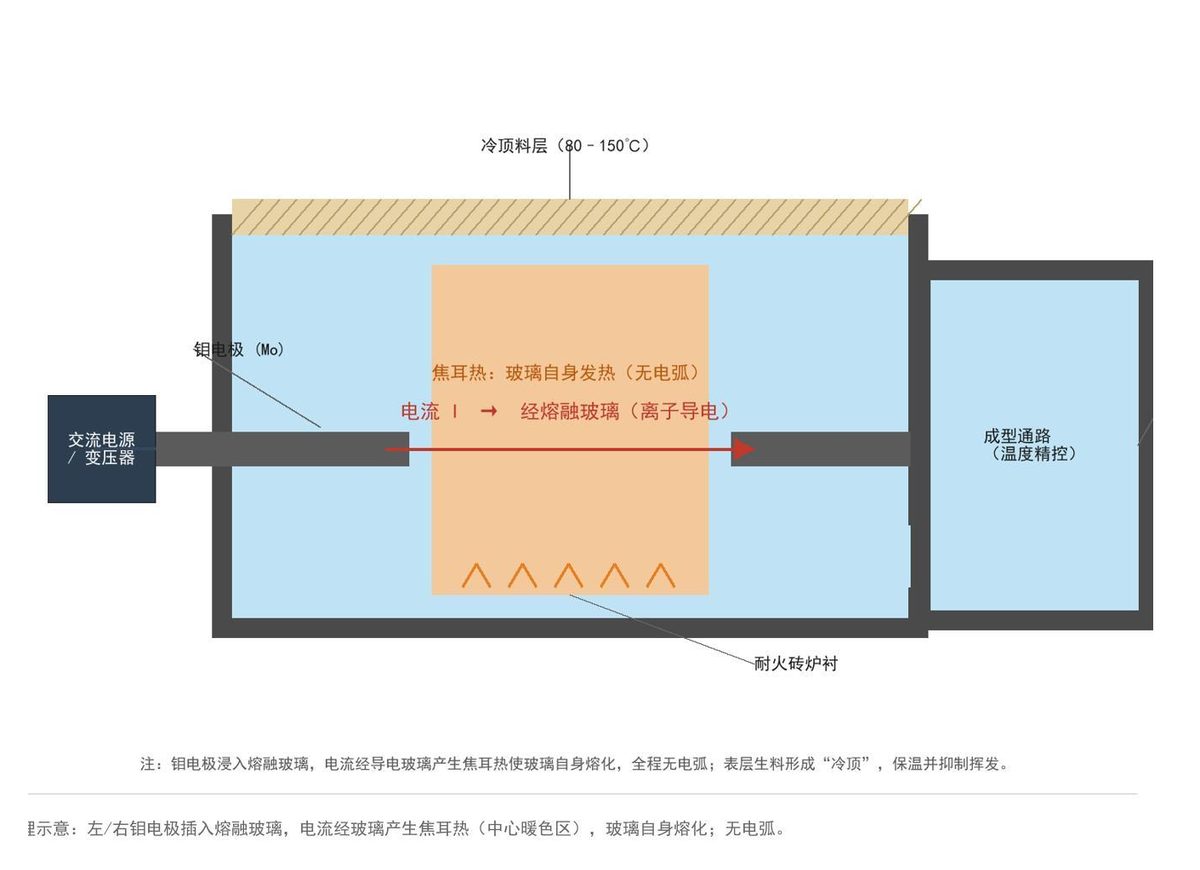
Both arc furnaces and electric melting furnaces use electricity, but the heating mechanism is completely different. An arc furnace strikes an arc across a gas gap between electrode and charge, and the heat reaches the material by radiation and convection from that arc. An electric melting furnace is a resistance-heated unit: the electrodes are immersed directly in the molten glass, current enters the melt, and the glass's own resistance generates the heat. This is Joule heating, governed by the familiar Q = I²Rt.
Why is there no arc? An arc needs a gas gap between electrode and material, and that gap has to be broken down electrically. In an electric melting furnace the electrode is always immersed in a continuous high-temperature melt, so the contact is a stable ohmic one. The electrical duty sits in the low-voltage, high-current range, and the control objective is precisely to avoid local current concentration and discharge. In an electric melter an arc is an abnormality to be eliminated, not a mode of operation.
This also explains why certain components exist. The water-cooled jacket around an electrode is not there to "cool an arc"; it protects the section of the electrode above the glass line from oxidation. The 1–3 A/cm² current-density check is not about arc length either; it limits the current load on the electrode surface and the resulting melt convection. The full physics of ionic conduction and Joule heating is covered in a separate article and is not repeated here.
2. Misconception two: molybdenum conducts about one third as well as copper
The claim that molybdenum conducts 1.3 times better than copper inverts the order of magnitude. At 20 °C, annealed copper has a resistivity of about 1.7×10⁻⁸ Ω·m (roughly 17 nΩ·m) and defines the 100% IACS reference. Pure molybdenum is about 5.3×10⁻⁸ Ω·m (roughly 53 nΩ·m), which works out to about 32% IACS. For the same cross-section, molybdenum has roughly three times the resistance of copper and about one third of its conductivity.
So why does the glass industry still use molybdenum? Because copper cannot serve as an electrode in glass at 1,300 °C and above. Copper melts at about 1,084 °C, far below glass melting temperatures, and it would contaminate the melt. Molybdenum melts at about 2,620–2,623 °C, remains stable in reducing or neutral atmospheres in contact with glass, and has a thermal conductivity of roughly 138–142 W/(m·K) that helps carry heat out of the electrode body and avoid local overheating. Molybdenum's value is not high conductivity; it is conductivity that survives high temperature.
A one-line way to remember the division of labour: copper is the good conductor at room temperature, molybdenum is the heat-resistant conductor at furnace temperature. If busbars, clamps and circuit resistance are sized on the assumption that molybdenum conducts better than copper, the results will be systematically too small, and both clamp temperature rise and voltage drop will be underestimated.
| Property | Annealed copper | Pure molybdenum | What it means for electrode design |
|---|---|---|---|
| Resistivity at 20 °C | about 17 nΩ·m | about 53 nΩ·m | Circuit resistance is roughly triple; size busbars and clamps separately |
| Conductivity | 100% IACS | about 32% IACS | A heat-resistant conductor, not a good conductor |
| Melting point | about 1,084 °C | about 2,620–2,623 °C | Copper cannot enter glass above 1,300 °C |
| High-temperature behaviour | Low strength, softens | Good strength, creep resistant | Suits long-term immersed duty |
3. Misconception three: the service temperature is not above 3,000 °C
The 3,000 °C figure usually comes from confusing melting point with service temperature, or from extrapolating a short-term vacuum limit into a glass furnace. Molybdenum melts at about 2,620–2,623 °C; glass melting runs at roughly 1,300–1,600 °C; and the long-term service limit of molybdenum parts under oxygen-free conditions is about 1,600–1,650 °C. The margin is real, but it is measured in hundreds of degrees, not in more than a thousand.
Oxidation deserves more attention than the melting point. In air, molybdenum starts to oxidise noticeably from about 400 °C, and above 600 °C it forms volatile molybdenum trioxide, with the rate climbing quickly with temperature. In practice the electrode thins, necks down just above the glass line, and eventually breaks. What limits electrode life in a melter is therefore rarely the melting point; it is whether the section above the glass line is protected. Water-cooled jackets, inert-gas blanketing and oxidation-resistant coatings are all designed around that 400–600 °C oxidation boundary.
This also explains a familiar shop-floor observation: the glass is not running especially hot, yet the electrode still fails near the surface. The cause is usually not the melting zone but the oxidising band above the glass line.
4. What the three misconceptions cost in practice
An incorrect mechanism propagates through the design chain:
- Reading the furnace as an arc furnace shifts attention to electrode spacing and "striking", away from current density and current-field uniformity, and shows up later as local overheating and uneven electrode wear.
- Assuming molybdenum out-conducts copper under-sizes busbars, clamps and short-network cross-sections, raising clamp temperatures in service and, in severe cases, causing arcing and voltage-drop losses.
- Assuming 3,000 °C capability leads to under-designed cooling and blanketing above the glass line, so electrodes fail at the neck well short of expected life.
These errors compound during cold start-up. Molybdenum resistivity rises with temperature, so cold resistance is low; add an under-sized circuit and both inrush current and temperature rise exceed expectations. Start-up should therefore follow the tap table step by step, with measured circuit resistance used to verify the wiring.
5. Using the numbers correctly: a checklist you can verify
The table collects the key figures used above so they can be checked item by item in a design review. The values are common ranges from published technical literature and engineering practice; the actual figure depends on grade, purity, condition and the supplier's measurements.
| Parameter | Typical reference | How to read it |
|---|---|---|
| Melting point | about 2,620–2,623 °C | A material property, not a service temperature |
| Long-term service limit (oxygen-free) | about 1,600–1,650 °C | Depends on support structure, load and atmosphere |
| Glass melting temperature | about 1,300–1,600 °C | Varies widely; solar and pharmaceutical glass run hotter |
| Onset of noticeable oxidation in air | about 400 °C | Volatile MoO₃ forms above 600 °C |
| Resistivity at 20 °C | about 53 nΩ·m | Roughly three times copper |
| Conductivity | about 32% IACS | Literature commonly cites 30–34% |
| Thermal conductivity | about 138–142 W/(m·K) | Helps remove heat from the electrode body |
| Density | ≥10.2 g/cm³ | Density drives erosion resistance and life |
| Current density in glass furnaces | 1–3 A/cm² | All-electric melters near the top, boosting near the bottom |
One more caveat: whether these figures apply depends on local electricity prices and grid conditions. All-electric melting ties energy cost almost entirely to the electricity tariff. Photovoltaic glass clusters such as Fengyang and Bengbu in Anhui or Suqian in Jiangsu, and container glass regions such as Zibo in Shandong or Shahe in Hebei, differ considerably in grid structure and time-of-use tariffs, so the same current density and power configuration can produce a completely different economic result elsewhere. The data travel; the calculation has to be local.
6. Conclusion: getting the "heavy-duty" story right
The real strength of a molybdenum electrode melting furnace is not the drama of an arc. It is three unglamorous facts: the glass heats itself, a molybdenum electrode survives 1,300–1,600 °C to deliver the current, and control plus cooling keep that heat where it belongs. Once the three boundaries are clear — no arc, Joule heating, heat-resistant rather than superconducting — selection and operating decisions rest on correct premises.
For buyers and process engineers alike, the practical move is to treat the checklist above as a shared reference. Whenever someone claims that molybdenum out-conducts copper or that 3,000 °C is fine, go back to the melting point, the resistivity and the oxidation temperature before discussing the proposal.
Frequently asked questions
Is a molybdenum electrode melting furnace an arc furnace?
No. It is a resistance-heated furnace: the electrodes are immersed in the glass, and the glass's own resistance produces Joule heating. No arc occurs, and an arc inside an electric melter is an abnormality to be eliminated.
Does molybdenum conduct 1.3 times better than copper?
No, the opposite. At 20 °C copper is about 17 nΩ·m and molybdenum about 53 nΩ·m, so molybdenum conducts at roughly 32% IACS, about one third of copper, with about three times the resistance.
Can molybdenum electrodes operate above 3,000 °C?
No. Molybdenum melts at about 2,620–2,623 °C, and its long-term service limit in oxygen-free conditions is around 1,600–1,650 °C. Glass melting runs at about 1,300–1,600 °C, so there is margin, but no 3,000 °C duty exists.
Why do molybdenum electrodes need water cooling?
Because molybdenum oxidises noticeably in air from about 400 °C and forms volatile molybdenum trioxide above 600 °C. A water-cooled jacket protects the electrode neck above the glass line and prevents it from thinning and breaking.
Why is an electric melter more efficient than a flame furnace?
Heat is generated inside the glass itself instead of being transferred through the combustion space and furnace walls. Industry figures typically quote 75–85% for all-electric melting against 30–40% for flame furnaces, with actual values depending on furnace type and pull rate.
Do molybdenum electrodes erode in glass?
Yes, but at a controllable rate. Erosion depends on glass composition, temperature, current density and electrode density, which is why current density must be checked for each duty and incoming quality controlled through density, grain structure and ultrasonic testing.
References and further reading
- How a glass electric furnace works: from ionic conduction to Joule heating
- How molybdenum resistivity changes with temperature
- Contact resistance and clamp design for molybdenum electrodes
- Selecting a glass electric furnace: all-electric, boosting and flame furnaces compared
- Molybdenum electrodes for glass melting furnaces: specifications
Standards applied: electrode products follow YS/T 1312-2019; molybdenum rods reference ASTM B387 / GB/T 17792; molybdenum plates and discs reference ASTM B386 / GB/T 3876.
Note: this article shares general industry and technical information and is not purchasing, investment or legal advice. Specific parameters and results are governed by the mutual technical agreement and factory inspection records.
Related products
Electrodes and high-temperature molybdenum parts for this duty — specifications and selection notes are on the product pages.
Product information

Glass melting furnace molybdenum electrode
For electric boosting and all-electric melting of container, packaging, pharmaceutical, photovoltaic and electronic glass, compatible with mainstream refractories and furnace designs.
View specifications →
Molybdenum stream mouth
Discharge nozzle at the end of fiberglass and aluminosilicate fiber forehearths; water-cooled or water-free oxidation protection, high-temperature and anti-clogging, custom to furnace drawings.
View specifications →
Molybdenum disc
Circular sheet made from high-purity molybdenum powder by powder metallurgy and rolling; used for furnace heating elements, heat shields, boats and sputtering targets.
View specifications →

