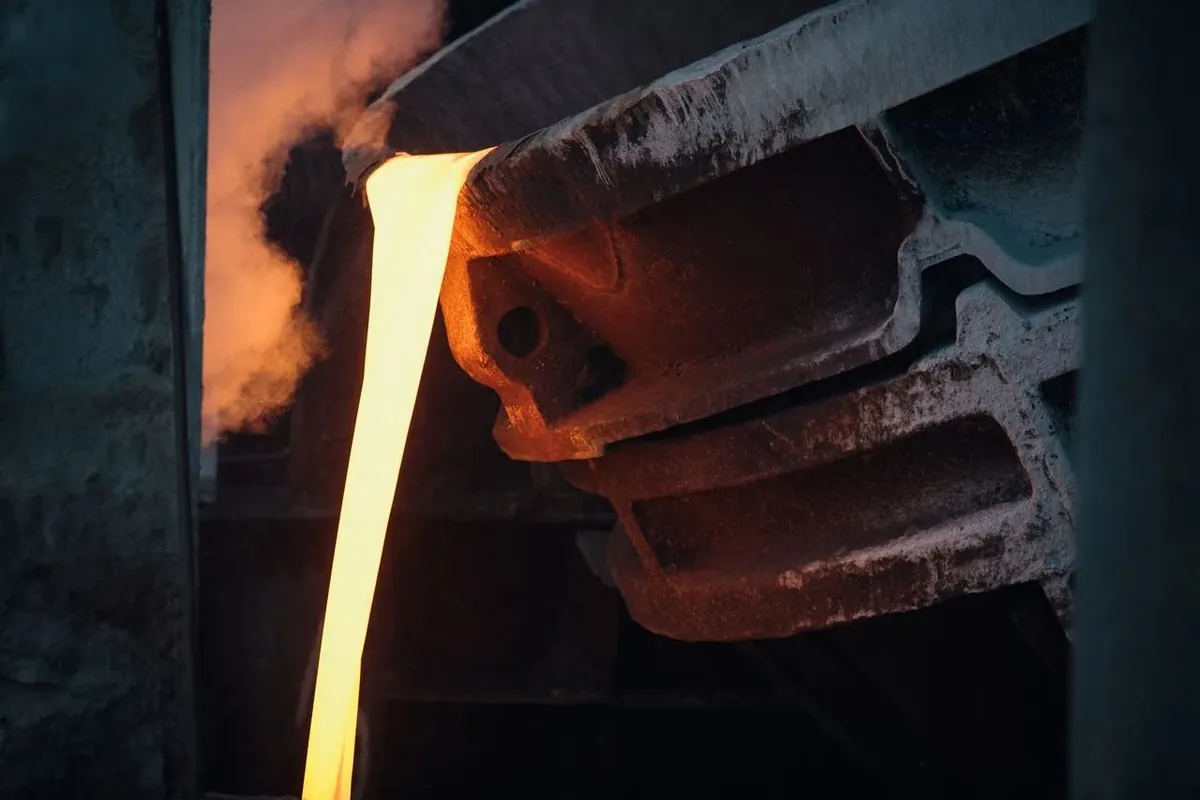
Specification Requirements for Molybdenum Crucibles in Sapphire Crystal Growth Furnaces
WeiBeam · Electrode solutions for high-temperature melting
In a sapphire growth furnace the molybdenum crucible must hold alumina melt at around 2100 °C and also take part in heat-field conduction and gas flow. Comparing the crucible geometry required by the Kyropoulos, heat-exchange and edge-defined film-fed growth methods, this article explains how opening diameter, melt level, roundness, wall thickness and bottom structure must match, and gives checklists for incoming inspection, pre-furnace preparation and scrapping.
Sapphire melts above 2000 °C, and the melt temperature during growth approaches 2100 °C. The crucible here is not merely a container: it also takes part in heat-field conduction and in the gas flow inside the furnace. If selection looks only at the temperature rating and ignores dimensional deviation and the condition of the inner wall, problems such as sticking, buildup and a shifted temperature field can appear during seeding and the constant-diameter stage, and the cost of later troubleshooting far exceeds the cost of settling the specification up front. The following sections run through growth method, heat-field matching, dimensions and surface, and inspection and scrapping.
1. The Growth Method Determines Crucible Geometry
The three growth methods place clearly different demands on the crucible body. The Kyropoulos method usually uses an open crucible with a flanged rim, with the seed lowered from above, so both operation and observation depend on the opening; the heat-exchange method places the heat exchanger at the bottom of the crucible, and the base is often machined with a locating step to ensure contact with the exchange surface; the edge-defined film-fed growth method uses a narrow, elongated crucible with a die, delivering melt to the growth interface by capillary action. Choose the wrong geometry and no amount of dimensional precision elsewhere will compensate.
| Method | Crucible form | Key dimensions | Points of attention |
|---|---|---|---|
| Kyropoulos | Open, flanged rim, large-diameter body | Inner diameter, height, roundness, flange flatness | Melt level control, sticking, handling tooling |
| Heat exchange | Locating step, heat exchange at the base | Base flatness, step dimensions, wall thickness | Contact thermal resistance, base temperature uniformity |
| Edge-defined film-fed growth | Narrow elongated crucible combined with a die | Cavity length and width, wall thickness, die gap | Capillary feed, edge heat loss |
On applicable standards, electrode products are controlled to YS/T 1312-2019 Molybdenum Electrodes; molybdenum rods follow ASTM B387 / GB/T 17792; molybdenum plates and discs follow ASTM B386 / GB/T 3876, and acceptance relies on the quality certificate and measured records.
The forms in the table are common practice; the furnace design and contract drawings govern. Both molybdenum and tungsten are used in sapphire growth: molybdenum balances machinability against cost and suits crucible bodies of more complex shape that require turning and welding in combination, while tungsten has its place at higher temperature or in specific atmospheres. Material selection should be settled together with the furnace type and the vacuum or inert gas conditions.
A change in crucible geometry usually pulls the whole heat field with it. Enlarging the crucible diameter to raise output per run means the insulation shields, heaters and support base all have to be adjusted; if only the crucible is replaced while the old heat field is retained, the ratio of edge heat loss to central heat input changes and defects tend to appear in the lower part of the crystal. A redesign should start with heat-field calculation and then fix the crucible dimensions; reversing that order is expensive.
2. Heat-Field Matching: Opening Diameter and Shield Clearance
The opening diameter must leave clearance to the inner diameter of the insulation shield in the furnace. If the clearance is too small, the thermal expansion of the crucible and the insulation material are out of step during heat-up and press against each other, deforming the crucible at best and cracking it at worst; if the clearance is too large, the crucible edge loses heat too quickly, the melt surface temperature becomes uneven, and during seeding the edge tends to solidify first.
The clearance value depends on crucible diameter, insulation material type and heating rate; in engineering it is usually chosen initially by experience and then corrected by a heat-up trial with an empty furnace. The drawing should show the crucible outer diameter, the shield inner diameter and the permitted eccentricity together, rather than giving only a nominal clearance and leaving each party to work from its own datum during assembly.
The position of the crucible in the heat field also affects the temperature distribution. If the body sits high, the top approaches the upper edge of the shield and the heat-loss path changes; if low, the distance from the base to the heater shrinks and the bottom temperature rises. When replacing a crucible, copying the old outline without checking the assembly height can shift the whole temperature field, showing up as difficult seeding or an unstable growth rate in the constant-diameter stage.
3. Height and Melt Level: Charge Weight and Process Window
Crucible height is set by the charge weight and by melt level control. If the level is too high, the distance between seed and melt shortens and necking is hard to stabilise; if too low, convection weakens and the lower part of the crystal tends to trap bubbles or inclusions. Most processes keep the initial level at 60 to 70 percent of crucible height and reserve margin for the finishing stage.
Charge weight affects not only the level but the heat capacity of the melt. A large charge keeps melt temperature fluctuations small but lengthens heat-up and raises energy consumption; a small charge heats quickly, but the level falls quickly too and the constant-diameter stage needs more frequent compensation. Once crucible height is fixed, the charge weight should be back-calculated from the target level and the crystal weight, not simply filled to the crucible volume.
Another issue with a falling level is the exposed area. As the level drops during growth, the upper inner wall moves from immersed to exposed; if the furnace atmosphere contains oxygen, the molybdenum oxidizes and may fall into the melt. A deeper crucible design can ease this, but adds wall thickness and heat capacity. Writing the range of level change into the process card is more practical than specifying only the initial level.
4. Roundness, Wall Thickness and Bottom Structure
Roundness is often overlooked. Once ellipticity appears on the inner wall, melt convection forms fixed hot and cold zones, and in the constant-diameter stage one direction grows faster than the other, leaving the crystal cross-section out of round. At acceptance, take inner diameter readings at several heights and record the spread of the differences rather than filling in a single measured value.
| Location | Reference range | Test method | Consequence if out of tolerance |
|---|---|---|---|
| Inner diameter | Per drawing, tolerance ±0.3–0.5 mm | Inside micrometer | Asymmetric melt convection, charge weight deviation |
| Roundness | ≤0.2–0.4 mm | Multi-section measurement | Crystal cross-section departs from circular |
| Side wall thickness | 3–6 mm, slightly thicker at the base | Ultrasonic thickness gauge, calipers | Thermal stress concentration or collapse at high temperature |
| Base flatness | ≤0.1–0.2 mm | Surface plate and feeler gauge | Uneven contact thermal resistance, temperature patches at the base |
| Inner wall roughness | Ra 1.6–3.2 μm | Roughness tester, visual | Buildup, bubble nucleation |
The values above are typical values and reference ranges; actual service conditions and the contract govern. Wall thickness affects both thermal shock resistance and conduction: too thick and heat storage is high, the temperature difference across the wall widens during heat-up and thermal stress concentrates; too thin and creep and sag occur under long-term high temperature and the hydrostatic pressure of the melt. The usual approach is to keep a broadly uniform wall thickness over the height and thicken the base to withstand charging impact.
Base flatness determines the contact thermal resistance between the crucible and the support base or heat exchanger. If the base has local high spots, contact is only at a few points and temperature patches appear at the bottom of the melt. After turning, bring flatness within the drawing range and deburr; the locating step of the heat-exchange method must also be trial-fitted to the heat exchanger to confirm clearance and concentricity.
5. Surface Condition and Inner Wall Treatment
The inner wall is not better simply because it is smoother. A suitable roughness helps the melt wet uniformly and also reduces buildup; too rough a surface becomes a nucleation site for bubbles. In production, a light polish after turning is usual, with no deep tool marks or pits visible. Roughness requirements for the working section, the flange and the outer wall should be specified separately; applying a single value to all of them is not reasonable.
The direction of turning marks also matters. Circumferential marks tend to retain bubbles when the level fluctuates, while longitudinal marks may guide melt to climb the wall. Most practice is to use finer circumferential marks on the working section with a light polish to reduce retention, and to ensure that the base and transition fillets are smooth to avoid stress concentration.
Cleaning and drying are essential steps before charging. Cutting fluid, hand sweat and dust residues vaporize during heat-up, contaminating the melt or creating a locally reducing atmosphere. After cleaning, dry thoroughly, and use clean gloves and dedicated tooling during transfer to avoid secondary contamination. For a growth furnace these operations usually pay back more than switching to a more expensive material.
6. High-Temperature Strength, Recrystallization and Deformation
The strength of molybdenum falls as temperature rises, and near the sapphire melting range creep resistance becomes the key to crucible life. Under a long charge of melt, the wall slowly deforms under its own weight and the hydrostatic pressure of the melt, showing up as an ovalized rim or a bulging side wall; once deformed, the clearance to the shield changes and the temperature field shifts with it.
Grain structure affects resistance to deformation. A fine-grained structure elongated along the direction of load performs better in creep; a coarse-grained or incompletely recrystallized structure softens locally at high temperature. At purchase, ask the supplier to state the forming method and heat-treatment schedule, and judge with metallographic sampling rather than looking only at purity and density.
Support method matters too. If the crucible is supported only at the base, the side wall expands freely and has room to deform; if the outer wall fits the support base so tightly that thermal expansion is restrained, additional stress appears instead. The support base should be designed with radial expansion allowance and avoid local point contact. Checking contact with a feeler gauge after assembly is more reliable than judging by tapping.
7. Incoming Inspection and Pre-Furnace Preparation
- Check the material certificate and dimensional drawing, and confirm that inner diameter, height and wall thickness fall within drawing tolerance;
- Measure roundness with inside gauges along three or more sections, and mark the direction of deviation;
- Observe the inner wall and base for cracks, laminations, pits and abnormal colour patches;
- Check that the flange or locating step is complete, and trial-fit the handling tooling once;
- Measure base flatness and contact with the support base, and record the clearance distribution;
- Clean and dry to prevent residual cutting fluid from vaporizing and contaminating the melt during heat-up;
- Run one heat-up with an empty furnace, and record changes in crucible appearance and assembly clearance.
In incoming inspection, abnormal colour patches deserve attention. Local bluish or blackish areas may be oxidation or cleaning residue; they do not affect dimensions, but may continue to develop at high temperature. Once found, establish the cause and, if necessary, clean locally or return the part rather than taking the risk of charging it.
8. In-Service Wear and Scrapping
| Phenomenon | Possible cause | Action |
|---|---|---|
| Buildup on the inner wall | Rough surface, low melt-level temperature | Check surface condition and temperature field, adjust power |
| Bulging at the base | Uneven support, local overheating | Check base flatness and heater distribution |
| Rim deformation | Clamping stress, restrained thermal expansion | Check tooling and clearance, adjust the support base |
| Wall thinning | Long-term high-temperature volatilization and reaction with the melt | Measure thickness periodically, scrap by trend |
| Cracks on the inner wall | Thermal shock, charging impact | Stop use to avoid melt leakage |
Scrapping should not be based on run count alone. Wall thinning, rim ellipticity and base deformation should be the main criteria, with the change after each run recorded. If the same location on the same furnace type repeatedly shows buildup or deformation, the problem is most likely in the temperature field or the tooling rather than the crucible itself; only by matching the phenomenon to furnace runs and power curves can the cause be found.
Sticking is often attributed to the crucible surface when it may actually relate to melt-level temperature, pulling rate or atmosphere. In troubleshooting, look first at the temperature-field record and the charge weight, then at the inner wall condition; reversing the order easily leads to replacing a crucible that could still have been used.
9. Selection and Delivery Communication
The more precisely the specification is settled, the fewer variables remain in the growth process. When requesting a quotation, provide the furnace type, growth method, crucible inner diameter and height, level control range, charge weight, heating method and atmosphere conditions, and state the interface dimensions of the support base and the shield. With only an outline drawing, the supplier can only machine to conventional tolerance and assembly problems still have to be solved back at the drawing.
On delivery, a crucible is a fragile, thin-walled, large part, and packaging and transport directly affect the condition on arrival. Single-piece wooden crates, internal padding, rim protection and moisture-proofing should be written into the contract; after long-distance transport, open the crate and check the appearance and rim first, then measure dimensions. Agreeing acceptance items and acceptance rules in advance reduces disputes on arrival.
The crucible and the heat field of a sapphire growth furnace are one system, and a change in crucible dimensions usually requires the insulation structure and the power curve to be adjusted at the same time. Dimensional series for crucible products can be checked against the crucible product series; mating electrodes and structural parts for the heat field are shown on the crystal growth electrode page; other entries cover materials and processes.
Frequently asked questions
What common problems arise with roundness, wall thickness and bottom structure of molybdenum electrodes?
The usual approach is to keep a broadly uniform wall thickness over the height and thicken the base to withstand charging impact. Once ellipticity appears on the inner wall, melt convection forms fixed hot and cold zones, and in the constant-diameter stage one direction grows faster than the other, leaving the crystal cross-section out of round.
What should be covered in selection and delivery communication?
On delivery, a crucible is a fragile, thin-walled, large part, and packaging and transport directly affect the condition on arrival. When requesting a quotation, provide the furnace type, growth method, crucible inner diameter and height, level control range, charge weight, heating method and atmosphere conditions, and state the interface dimensions of the support base and the shield.
Which item in incoming inspection and pre-furnace preparation is most easily overlooked?
In incoming inspection, abnormal colour patches deserve attention. Once found, establish the cause and, if necessary, clean locally or return the part rather than taking the risk of charging it.
Note: this article shares general industry and technical information and is not purchasing, investment or legal advice. Specific parameters and results are governed by the mutual technical agreement and factory inspection records.
Related products
Electrodes and high-temperature molybdenum parts for this duty — specifications and selection notes are on the product pages.
Product information

Molybdenum crucible
Molybdenum crucibles for sapphire growth, vacuum sintering and high-temperature melting; heat and melt-erosion resistant, sized to the furnace.
View specifications →
Crystal growth molybdenum electrode
For heating in Czochralski growth furnaces for sapphire, optical crystals and laser crystals; high purity and high-temperature stability.
View specifications →
Molybdenum disc
Circular sheet made from high-purity molybdenum powder by powder metallurgy and rolling; used for furnace heating elements, heat shields, boats and sputtering targets.
View specifications →