Aluminosilicate Wool Classification Temperature, Thermal Conductivity and Price: Insulation Selection and Manufacturer Verification Guide
WeiBeam · Electrode solutions for high-temperature melting
Classification temperature, thermal conductivity and price are the three most misread numbers in aluminosilicate wool selection. This guide explains service-temperature margins, conductivity test conditions, insulation blanket design, mullite and polycrystalline alumina upgrades, supplier verification and acceptance.
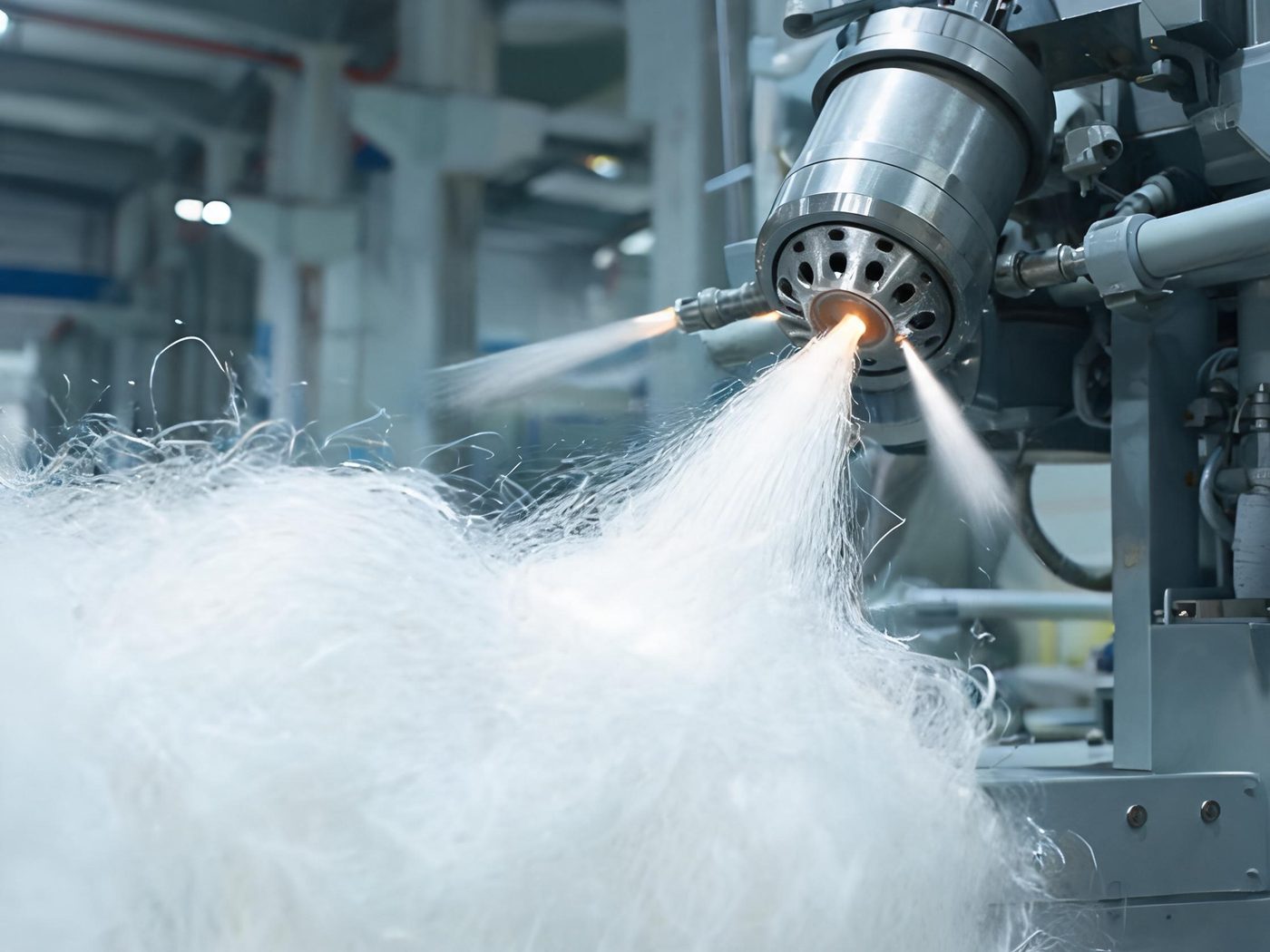
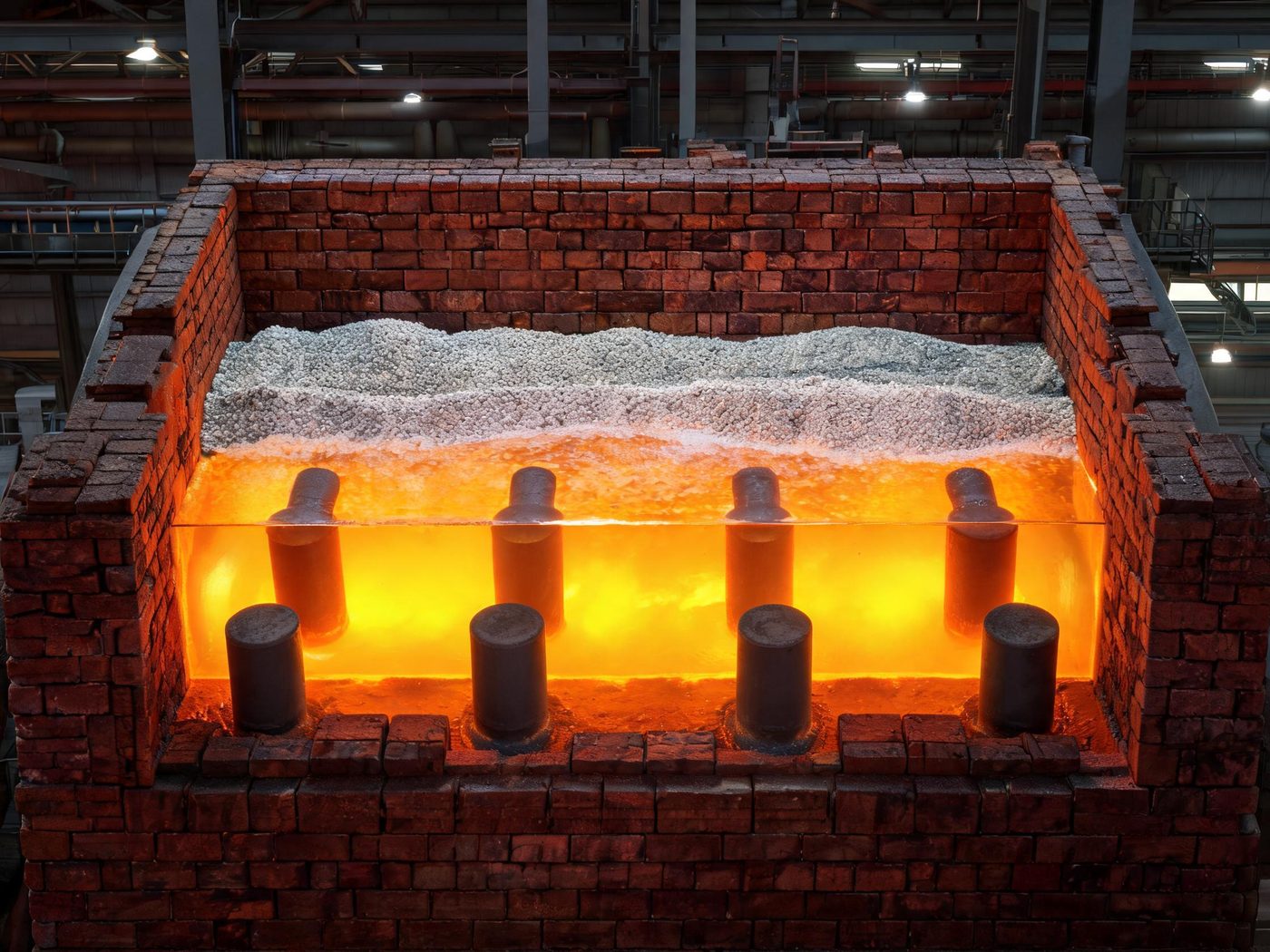
The short answer. Three numbers mislead buyers most often when selecting aluminosilicate wool: classification temperature, thermal conductivity and price per ton. Classification temperature answers "how hot can it survive briefly," not "what is the long-term service limit." Thermal conductivity must be read together with test temperature, density and moisture. Price is only comparable when material grade, density, thickness, packaging, freight and tax are aligned. Put all three back into the lining structure, then decide whether mullite fiber or polycrystalline alumina fiber is actually needed. Aluminosilicate wool is melted and fiberized in an electric furnace, and a stable melt depends on immersed molybdenum electrodes; front-end fluctuation travels all the way to fiber diameter, shot content and batch consistency.
This guide follows the sequence: classification temperature, thermal conductivity, insulation structure, mullite and polycrystalline alumina fiber, manufacturer and price, supplier verification, the melting front and an acceptance checklist. The temperatures, conductivity values and price logic cited are typical ranges and market reasoning from public information, not a quotation for any specific supplier. Actual projects should rely on test reports, contract technical annexes and site conditions.
1. Aluminosilicate wool classification temperature: what the number really answers
Classification temperature is the temperature grade a material can withstand under specified test conditions, usually related to linear shrinkage, refractoriness and chemical composition. Common grades include 1050°C, 1260°C, 1350°C and 1430°C; higher grades use zirconia-bearing, mullite or polycrystalline alumina fibers. A higher classification temperature generally means higher alumina content, lower impurities and higher raw-material and energy costs.
| Common grade | Typical alumina content | Classification temperature | Typical long-term service | Typical applications |
|---|---|---|---|---|
| Standard aluminosilicate wool | About 43%–47% | 1050°C | About 850–950°C | General furnace backup, pipe insulation |
| Standard grade | About 45%–50% | 1260°C | About 1000–1100°C | Kiln hot face, modules, blanket |
| High-purity grade | About 47%–52% | 1260°C | About 1050–1150°C | Hot face sensitive to contamination |
| High-alumina grade | About 52%–58% | 1350°C | About 1150–1250°C | High-temperature kilns, process heaters |
| Zirconia-bearing grade | About 45%–55% + ZrO₂ | 1430°C | About 1250–1350°C | High-temperature hot face, low shrinkage |
| Mullite fiber | About 70%–80% | About 1430–1600°C | About 1300–1500°C | High-temperature kilns, ceramic hot face |
| Polycrystalline alumina fiber | About 72%–95% | About 1600–1700°C | About 1450–1600°C | Ultra-high-temperature and crystal-growth furnaces |
The "typical long-term service" column is not a standard value; it is a conservative engineering range. Actual usability depends on atmosphere, contact with alkali or fluoride vapors, gas erosion, allowable shrinkage and maintenance cycle. Reducing atmospheres, moisture and alkali vapor accelerate crystallization and embrittlement. Two products with the same classification temperature can differ by a factor of two in service life.
1.1 Classification temperature is not service temperature
The classification test is usually a short-time heat treatment with linear shrinkage measurement, while an industrial furnace runs continuously. At high temperature, fibers gradually crystallize and grow, strength drops, and shrinkage and embrittlement appear. A 1260°C wool used continuously at 1260°C may look fine for a few months, then show wide shrinkage gaps and a powdery surface, raising the shell temperature. A margin of 100–200°C, adjusted by maintenance records from similar furnaces, is a more sensible approach.
1.2 Alumina content is not the only variable
Among 1260°C grades, high-purity and standard wool differ mainly in impurity content—especially iron, sodium and potassium. Higher impurities form low-melting phases at temperature and accelerate shrinkage. For glass, ceramics and electronic materials that are sensitive to contamination, the value of high-purity wool is not "more temperature resistance" but "less contamination introduced."
2. Aluminosilicate wool thermal conductivity: three premises behind the number
Thermal conductivity is the core parameter for insulation design, but it is not a fixed value. A quotation that says "conductivity 0.035" means little without test temperature, density and moisture content. Conductivity rises with temperature, changes with density (first falling, then rising) and deteriorates sharply when the material absorbs moisture.
| Mean temperature | Low-density blanket (about 96–128 kg/m³) | Medium-density blanket (about 128–160 kg/m³) | Fiber board (about 250–350 kg/m³) |
|---|---|---|---|
| 25°C | About 0.034–0.044 | About 0.036–0.046 | About 0.050–0.065 |
| 400°C | About 0.070–0.090 | About 0.075–0.095 | About 0.085–0.105 |
| 600°C | About 0.100–0.130 | About 0.105–0.135 | About 0.115–0.145 |
| 800°C | About 0.140–0.180 | About 0.145–0.185 | About 0.155–0.195 |
| 1000°C | About 0.180–0.230 | About 0.185–0.235 | About 0.200–0.250 |
Units are W/(m·K); values are typical engineering ranges. Actual data should come from a supplier report tested to GB/T 10294 or GB/T 10295. At room temperature, 0.035 versus 0.045 may look minor, but above 800°C the difference between densities and processes widens significantly. Using room-temperature data to design a high-temperature furnace is a common mistake.
2.1 Higher density is not always better
Heat transfer in fibrous insulation includes gas conduction, solid conduction through fibers and radiation. Too low a density means large pores and stronger convection and radiation; too high a density adds solid conduction paths and raises conductivity. Most aluminosilicate blankets perform best in the 96–160 kg/m³ range. Fiber board is denser for load bearing and erosion resistance, and its conductivity is higher; board should not simply replace blanket over a large insulation area.
2.2 Moisture and construction humidity
Moisture absorbed by the fiber forms conductive bridges in the pores and can multiply thermal conductivity. Store materials under cover, and dry a wet lining before heating. The dry-out curve should raise temperature in stages with holds, so water does not flash into steam and cause blanket bulging or module cracking. This matters especially in humid climates and coastal projects.
2.3 Using conductivity to compare quotations
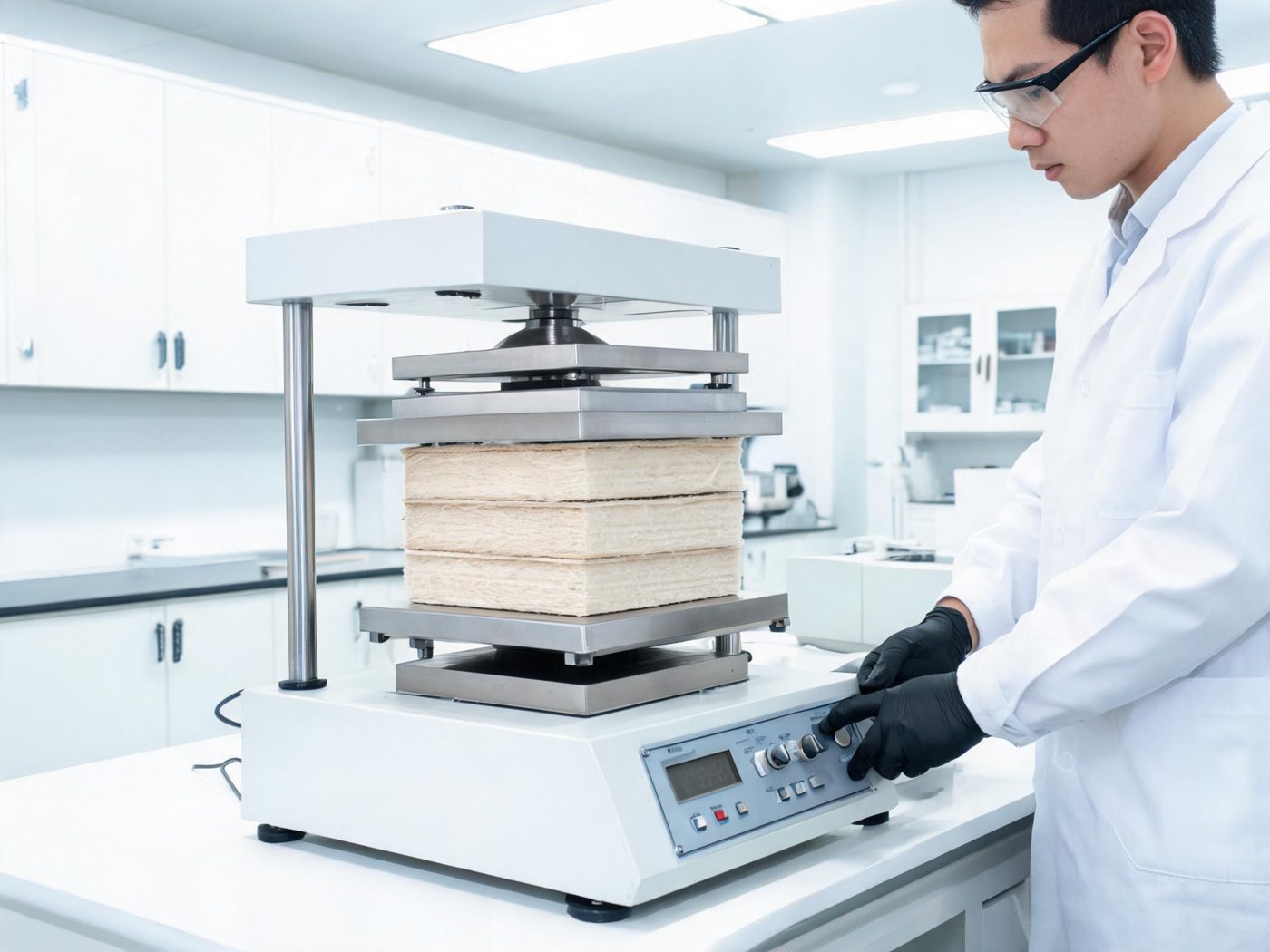
When comparing suppliers, align at least four items: test standard, mean temperature, specimen density and whether binders are included. A claim of "low conductivity" without conditions cannot be evaluated. Ask for a report at the same temperature point, with specimen density and thickness stated; use third-party retesting as arbitration when justified.

3. Insulation materials and insulation blanket: putting the numbers back into the lining
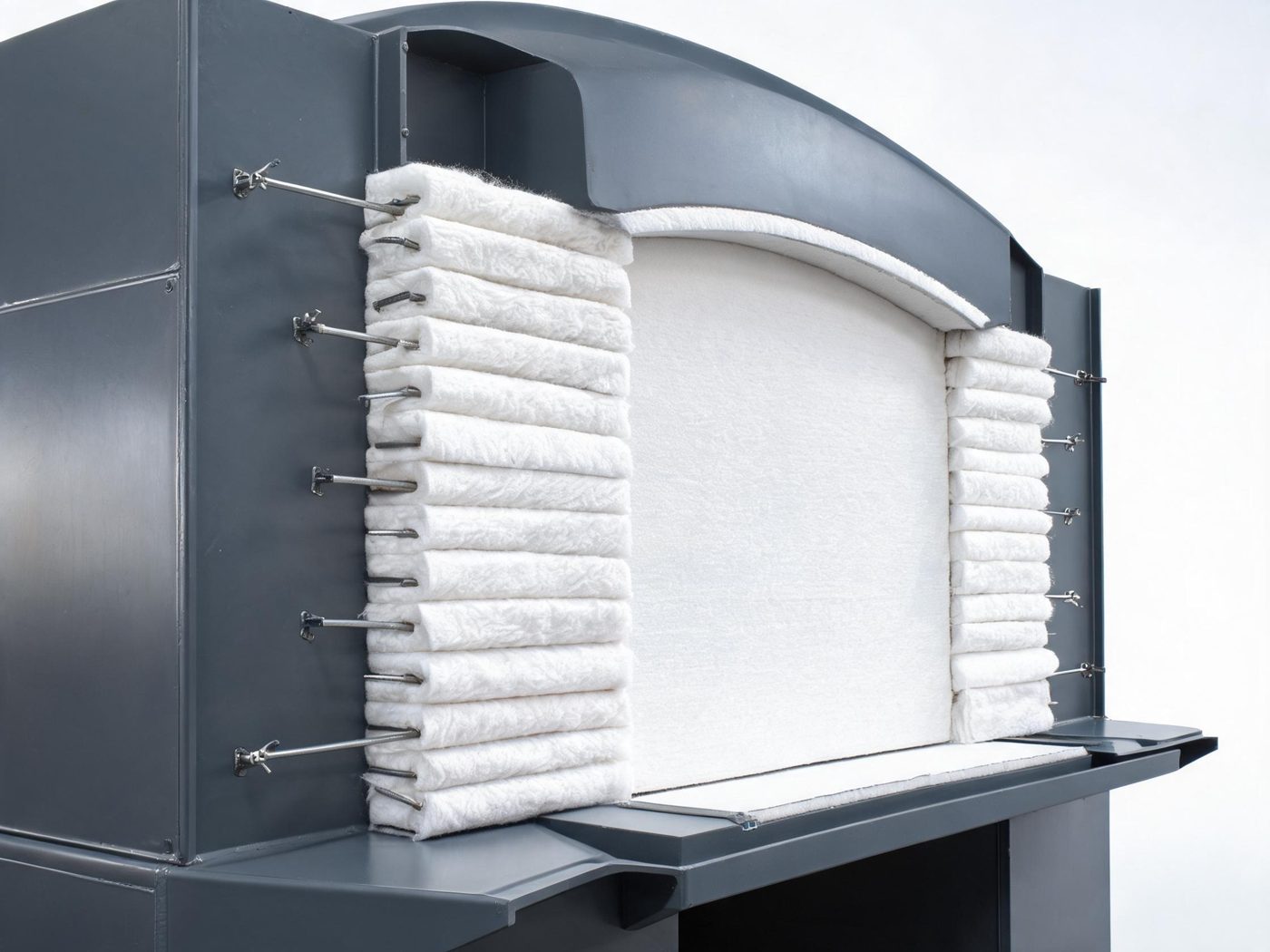
Insulation is not simply "laying a layer of wool." A sound lining usually consists of a hot face, an insulation layer, a backup layer and the steel shell, each with a different job: the hot face resists temperature, erosion and chemical attack; the insulation layer controls heat flow; the backup layer lowers the shell temperature and protects the steel; the shell provides structure and sealing. Aluminosilicate insulation blanket is mostly used in the insulation and backup layers, fiber board where load or erosion resistance is needed, and fiber paper for thin layers and joints.
3.1 Staggered layers and compression
Multilayer blanket should be installed with staggered joints to avoid through-gaps and thermal bridges. Overlap length is specified by design, often at least 100 mm. The transition between modules and blanket must be tight; loose wool should not be used as a casual filler. Roof areas must also account for self-weight sagging, with supports or folded blocks where necessary.
3.2 How to determine blanket density and thickness
Density and thickness are not arbitrary; they follow from allowable heat flow, shell temperature and investment cost. A common engineering approach calculates total thermal resistance from hot-face temperature, allowable shell temperature and ambient temperature, then distributes thickness according to each layer's conductivity. Batch furnaces also consider heat storage and heating rate; continuous furnaces emphasize steady-state heat flow and long-term shrinkage. Backup layers commonly use 96–128 kg/m³, hot-face modules 128–160 kg/m³, subject to supplier recommendations and comparable cases.
3.3 Pipes, tanks and irregular areas
Pipe insulation must handle elbows, valves, flanges and supports; tanks need attention at shell welds and top edges; irregular areas use fiber paper, loose wool or folded blocks. All metal penetrations need expansion space, packed with fiber paper or loose wool, so the blanket is not pushed through when hot.
4. Mullite fiber and polycrystalline alumina fiber: when to upgrade
When service temperature exceeds 1350°C, or when the process is extremely sensitive to shrinkage and contamination even at a moderate temperature, standard aluminosilicate wool is not enough. Mullite fiber and polycrystalline alumina fiber are two upgrade paths, with very different cost, process and application profiles.
| Item | Mullite fiber | Polycrystalline alumina fiber |
|---|---|---|
| Main composition | Al₂O₃ about 70%–80%, balance SiO₂ | Al₂O₃ about 72%–95% |
| Classification temperature | About 1430–1600°C | About 1600–1700°C |
| Long-term service | About 1300–1500°C | About 1450–1600°C |
| Advantages | Good high-temperature shrinkage and chemical resistance, moderate cost | Very high temperature resistance, low impurities, clean service |
| Limitations | Still contains SiO₂; limited life in strong alkali or fluoride atmospheres | High cost, brittle, demanding anchoring and installation |
| Typical uses | Ceramic kilns, metallurgical heaters, reformer furnaces | Crystal growth furnaces, ultra-high-temperature test furnaces, aerospace thermal protection |
Choose the path by asking three questions: Is the temperature truly above 1350°C? Does contamination affect the product? What are the budget and maintenance cycle? Some projects can solve the problem with zirconia-bearing aluminosilicate wool but choose polycrystalline alumina fiber, doubling investment for little gain. Others run at 1500°C continuously with ordinary high-alumina wool and see embrittlement within six months. Ask for cases at the same temperature and atmosphere—not just a classification table.
5. Aluminosilicate wool manufacturers and price: why quotations differ by 30%
"How much is aluminosilicate wool per ton" is a common search, but a single number is often misleading. Price differences usually come from six factors: material grade, density and thickness, fiberizing process, packaging and freight, order quantity, and payment/invoicing terms. For the same 1260°C needled blanket, high-purity and standard wool have different raw-material costs; a nominal 128 kg/m³ product with a 5%–10% density deviation changes material usage significantly; spun and blown blanket also carry different process costs.
5.1 Align the quotation basis
Compare prices in two units—per ton and per square meter at the design density and thickness—and state material grade, classification temperature, nominal density, thickness, dimensions, packaging, tax, freight responsibility, minimum order quantity and lead time. Comparing only "price per ton" easily leads to a low bid that consumes more material on site.
5.2 Three common sources of low price
- Insufficient density. A nominal 128 kg/m³ product at 110 kg/m³ uses less material per square meter and loses both insulation and resilience.
- Grade substitution. 1050°C wool sold as 1260°C, or standard wool sold as high-purity. Short-term checks may not reveal it, but shrinkage appears later.
- High shot content. Poor fiberizing control produces shot, a harsh feel and worse conductivity and handling.
Lower price is not automatically better, and higher price is not proof of quality. Set technical thresholds, require quotations on the same basis, and then judge samples, reports and cases together.
6. How to verify an aluminosilicate wool manufacturer
Many online "manufacturers" are traders, brand owners or repackagers. Verification can start with six items:
- Business license and production address. Check whether the scope includes refractory fiber production and whether the registered and production addresses match; visit the plant when possible.
- Production equipment. Look for an electric melting furnace, fiberizing equipment, needling line, curing oven and cutting equipment; confirm capacity matches the order size.
- Testing capability. Check for thermal conductivity, shot content, linear shrinkage and tensile testing, and whether batch reports are available.
- Quality documents. Review third-party reports, certificates of conformity and standards; note specimen density, test temperature and production date.
- Cases and repeat orders. Ask for cases at the same temperature and in the same industry, ideally with contactable customers; repeat business is more persuasive than a brochure.
- Sample consistency. Compare a sample from the same batch with bulk delivery—color, feel, thickness and density—and check whether batch-to-batch variation is controlled.
A genuine source manufacturer is usually willing to open the production site and provide batch traceability and test data. Be cautious with suppliers who only send quotations and refuse to disclose a production address or test reports. For export projects, confirm English reports, MSDS, packaging marks and certificates of origin.
7. The melting front: the hidden effect of molybdenum electrodes on fiber performance
The quality of aluminosilicate wool is largely set when the melt enters the fiberizing unit. An electric melting furnace delivers energy through immersed electrodes; electrode purity, density and wear affect the melt temperature field, convection and impurity level. Uneven electrode wear creates cold zones and hot spots, the fiber diameter at the fiberizing end fluctuates and shot increases. High impurity electrodes can also carry iron into the melt, affecting fiber color and high-temperature performance.
When evaluating a wool manufacturer, look beyond needling, cutting and packaging to the melting furnace's electrode configuration and replacement cycle. Lines using molybdenum electrodes for ceramic fiber generally have better melt stability and electrode life. If you are upgrading a furnace, see rod versus plate electrode boundaries and electrode selection for ceramic fiber and rock wool melting. A stable front end is the foundation for reliable classification temperature, thermal conductivity and batch consistency.
8. Purchasing and acceptance checklist
| Stage | What to confirm | Evidence to keep |
|---|---|---|
| Selection | Long-term temperature, atmosphere, load, allowable shrinkage | Operating data, lining drawings, comparable cases |
| Quotation | Grade, density, thickness, packaging, freight, tax | Quotations on a unified basis |
| Incoming | Batch, color, feel, thickness, density | Sample photos, weighing records |
| Testing | Conductivity, shot, linear shrinkage, tensile strength | Third-party or mutually accepted reports |
| Installation | Staggered joints, overlap, anchors, expansion joints | Concealed-work photos, installation records |
| Dry-out | Heating curve, holding time, moisture removal | Dry-out curve and temperature records |
During acceptance, do not just check that a report exists. Confirm that the report matches the delivered batch, that specimen density matches the contract, and that test temperatures cover the actual service condition. For critical high-temperature continuous linings, retain sealed samples for later comparison and traceability.
FAQ
Is the classification temperature of aluminosilicate wool the maximum service temperature?
No. Classification temperature is a material grade. Continuous service must account for shrinkage, atmosphere, load and life margin, so the practical limit is usually one grade lower. Confirm the upper limit with linear-shrinkage data and comparable case histories.
Is lower thermal conductivity always better?
At the same test temperature, density and moisture condition, lower conductivity means better insulation. But materials of different density and form cannot be judged by one number: low-density blanket has low room-temperature conductivity but radiation increases at high temperature; fiber board is denser and more conductive, yet it carries load and resists erosion. Selection depends on the location in the lining.
How can I tell whether an aluminosilicate wool supplier is a real manufacturer?
Check the production address, melting furnace and fiberizing equipment, testing capability, batch traceability and comparable industry cases. A genuine manufacturer is usually willing to open the plant and provide test reports and batch samples. A supplier that offers only a quotation without explaining production is likely a trader or brand owner.
How do I choose between mullite fiber and polycrystalline alumina fiber?
For 1350–1500°C service with good shrinkage and corrosion resistance requirements, evaluate mullite fiber first. Above 1500°C, or where impurity and life requirements are extreme, consider polycrystalline alumina fiber. The cost difference is large, so use the upgrade only in the truly high-temperature zones rather than replacing the whole lining.
Is higher density always better for insulation blanket?
No. Too low a density leaves large pores and stronger convection and radiation; too high a density increases solid conduction, weight and cost. Backup layers commonly use 96–128 kg/m³ and hot-face modules 128–160 kg/m³, subject to thermal calculation and supplier recommendations.
If you are selecting a lining, comparing suppliers or checking incoming material, send us the operating temperature, atmosphere, layer thickness and current quotations. We can review the material grade, thermal conductivity, lining structure and acceptance items step by step. You are also welcome to contact us for samples and technical support.
Note: this article shares general industry and technical information and is not purchasing, investment or legal advice. Specific parameters and results are governed by the mutual technical agreement and factory inspection records.
Standards note: electrodes are controlled to YS/T 1312-2019 Molybdenum Electrodes; molybdenum rods to ASTM B387 / GB/T 17792; molybdenum plate and discs to ASTM B386 / GB/T 3876. Parameter ranges in this article summarise public technical data and engineering practice — actual values vary with furnace conditions and are governed by the technical agreement and inspection records.
Related products
Electrodes and high-temperature molybdenum parts for this duty — specifications and selection notes are on the product pages.
Product information

Ceramic fiber and refractory molybdenum electrode
For electric melting and fiberizing in ceramic fiber, rock wool and refractory fiber resistance furnaces; high-temperature erosion resistance for continuous production.
View specifications →
Rare-earth electrolysis molybdenum electrode
For high-temperature molten-salt electrolysis of rare-earth metals; good conductivity, molten-salt erosion resistance and stable cell operation.
View specifications →
Crystal growth molybdenum electrode
For heating in Czochralski growth furnaces for sapphire, optical crystals and laser crystals; high purity and high-temperature stability.
View specifications →