Ceramic Fiber Needled Blanket, Modules and Folded Blocks: Forms, Performance and Furnace Lining Selection
WeiBeam · Electrode solutions for high-temperature melting
Needled blanket, modules, folded blocks, fiber board, paper and insulation blanket are different forms of the same aluminosilicate fiber family. This guide explains their forming methods, density and thickness, pre-compression, anchoring and performance metrics, and how molybdenum electrodes in the melting furnace affect fiber consistency.
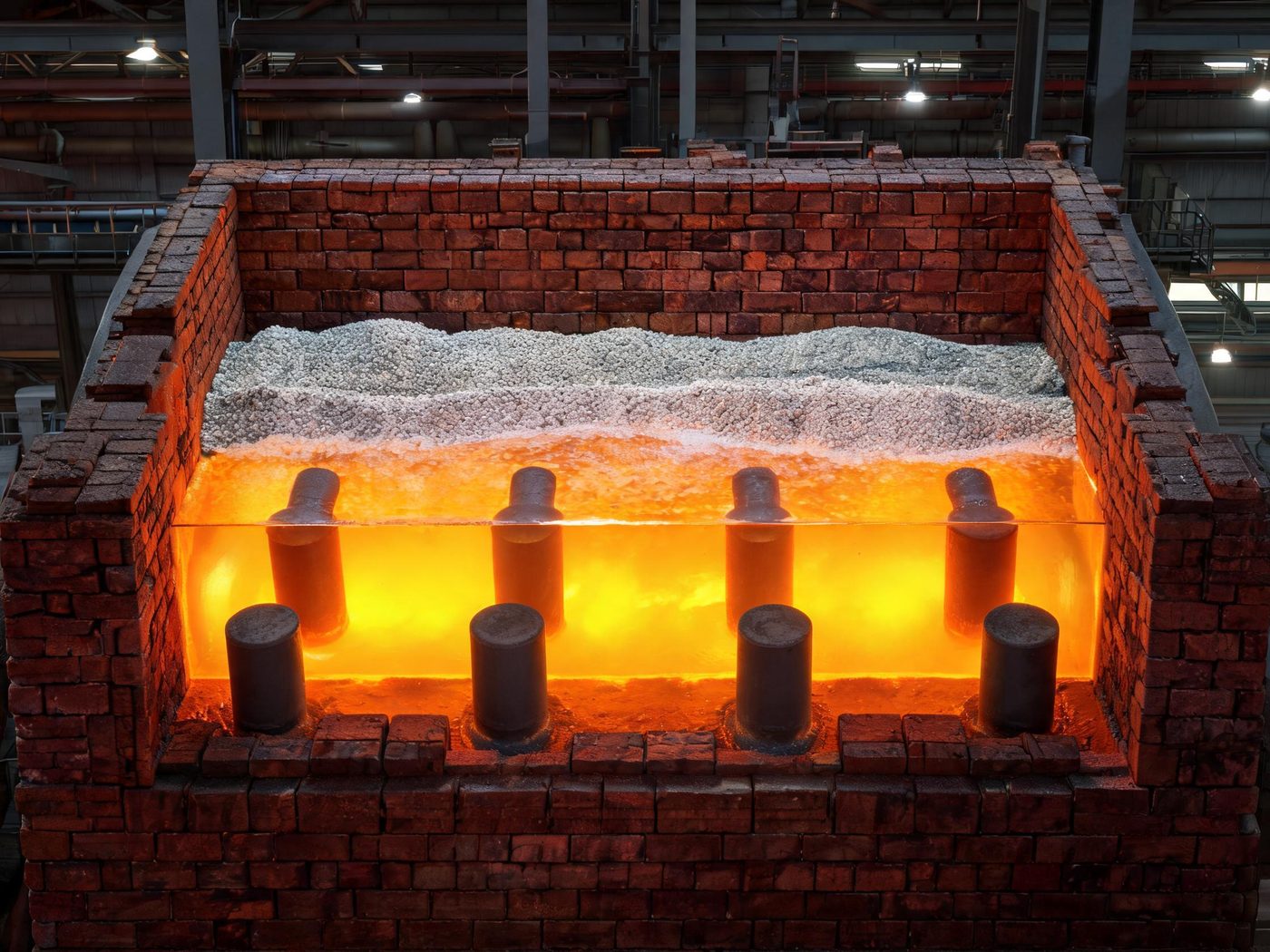
The short answer. Ceramic fiber needled blanket, modules, folded blocks, fiber board, fiber paper and insulation blanket are not six interchangeable materials. They are different forms along one chain—aluminosilicate wool, then blanket, then finished shapes. Blanket is the base product; modules and folded blocks are pre-compressed blanket units installed into a furnace lining; board and paper are made by different forming processes for rigid or thin applications. Selection starts with furnace type, temperature, atmosphere, mechanical load and installation window, then moves to form, density and thickness—not to a single classification temperature. All of these products begin in an electric melting furnace, where immersed molybdenum electrodes help hold the melt stable; a steady front end is what makes fiber diameter, shot content and color consistent downstream.
This guide follows the sequence: terminology, needled blanket, modules, folded blocks, board/paper/blanket, performance metrics, the melting front, a selection path and field problems. Densities, thicknesses and temperatures are typical ranges from public engineering practice; final values should be confirmed against supplier test data, current standards and the actual furnace condition.
1. First, untangle the names: how blanket, board, paper, modules and folded blocks relate
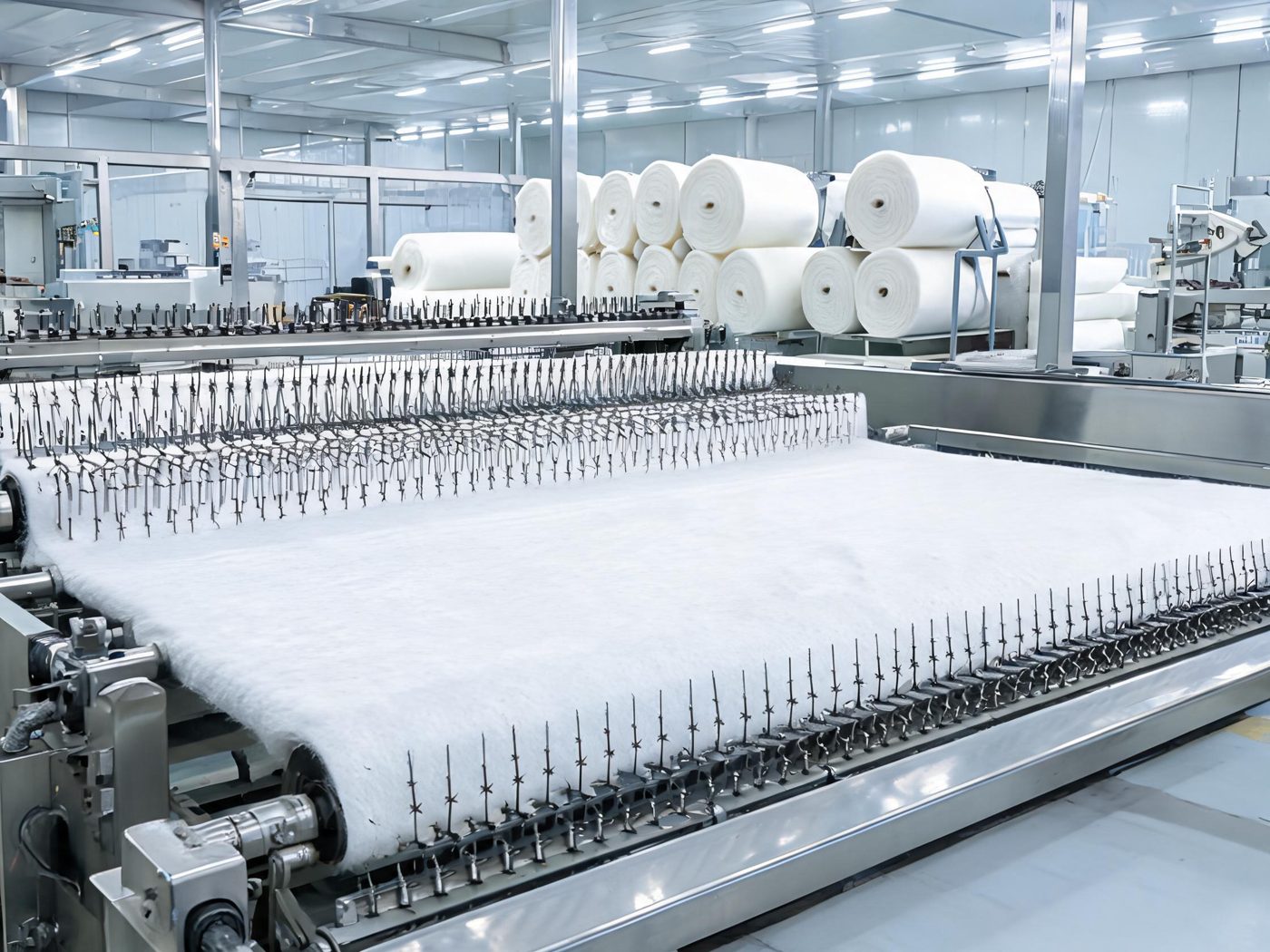
The relationship can be stated in one sentence: wool is the raw material, blanket is the base product, modules and folded blocks are installation forms of blanket, while board and paper are separate wet-formed products. Aluminosilicate wool is melted and fiberized into bulk wool. The wool is carded, cross-lapped and needle-punched into needled blanket. Blanket is pre-compressed to a specified size and fitted with anchors to become a module. Blanket folded in an accordion pattern and secured becomes a folded block. Fiber board is usually made by vacuum filtration or a wet process, and fiber paper is made by a papermaking route—dispersion, sheet forming, pressing and drying.
| Product form | Forming method | Typical density (kg/m³) | Typical thickness (mm) | Primary task |
|---|---|---|---|---|
| Aluminosilicate fiber blanket | Carding, cross-lapping, needling | 96–160 | 10–50 | Lining backup, pipe insulation, module base |
| Ceramic fiber module | Pre-compressed blanket + anchors | Depends on blanket and compression | 100–300 installed | Fast installation on hot face |
| Folded block | Folded blanket + fasteners | Depends on blanket and folds | 100–300 | Irregular areas, repairs, complex roofs |
| Aluminosilicate fiber board | Vacuum filtration / wet forming | 200–500 | 10–100 | Load bearing, erosion resistance, pads |
| Aluminosilicate fiber paper | Sheet forming, pressing, drying | 180–300 | 0.5–5 | Thin insulation, gaskets, expansion joints |
| Insulation blanket | Same family as fiber blanket | 96–128 | 10–50 | Pipes, tanks, furnace backup |
The important message is not the numbers but "one family, different tasks." Using a module as a load-bearing board, or paper to fill a large gap, is usually not a material failure—it is a form-selection error.
2. Ceramic fiber needled blanket: the step that turns wool into a lining material
2.1 What needle punching actually does
After carding and cross-lapping, most fibers lie horizontally and the layers are held together only by friction and a little entanglement. The blanket delaminates easily. Needle punching uses barbed needles to penetrate the web repeatedly, dragging surface fibers into inner layers and creating vertical fiber bundles that "stitch" the layers together. Multiple passes—top and bottom—raise interlayer bonding, tensile strength and dimensional stability.
Needle density, needle type, penetration depth and the number of passes determine how tight the blanket becomes. Too little needling produces a fuzzy, easily delaminated blanket that distorts during installation. Too much needling cuts large numbers of fibers and reduces strength and resilience. In practice, tensile strength, interlayer bonding and resilience are better indicators than a smooth surface appearance.
2.2 Density, thickness and compression recovery
Needled blanket commonly ranges from 96 to 160 kg/m³ and 10 to 50 mm thick. Higher density usually means more fiber per unit volume, better room-temperature strength, better resistance to gas flow and more stable insulation—but also more weight, higher cost and harder handling. Lower density feels softer and conforms better, yet it can be compressed during transport and installation, losing resilience and opening gaps later.
Distinguish supplied thickness from installed thickness. A lining is usually designed as multiple layers—for example, 20 mm hot face plus two 20 mm backup layers for 60 mm total—while modules require pre-compression to be included. To judge blanket quality, measure the original thickness, compress a sample by hand, release it and watch the recovery speed and permanent set. Slow recovery and deep, non-recovering marks mean the blanket will struggle to stay tight in service.
2.3 Why spun and blown blanket feel different
Blanket made from spun fiber and blanket made from blown fiber behave differently. Spun fiber is coarser and longer with relatively low shot content; blanket made from it has higher tensile strength and better resilience, making it suitable for hot-face modules, load-bearing areas and linings that are handled repeatedly. Blown fiber is finer and shorter; its blanket is softer with slightly lower thermal conductivity, which suits backup insulation and applications requiring close conformity. Neither is universally better—the application decides.

If the melt temperature fluctuates and contains impurities, fiber diameter distribution widens and shot content rises. Hard spots can then appear in the blanket and tear surrounding fibers during installation, creating local weak zones. That is why the difference between spinning and blowing affects not only how the wool feels, but also how blanket and modules perform on site.
3. Ceramic fiber modules: pre-compressed blanket for the furnace lining
3.1 A module is not just a thicker blanket
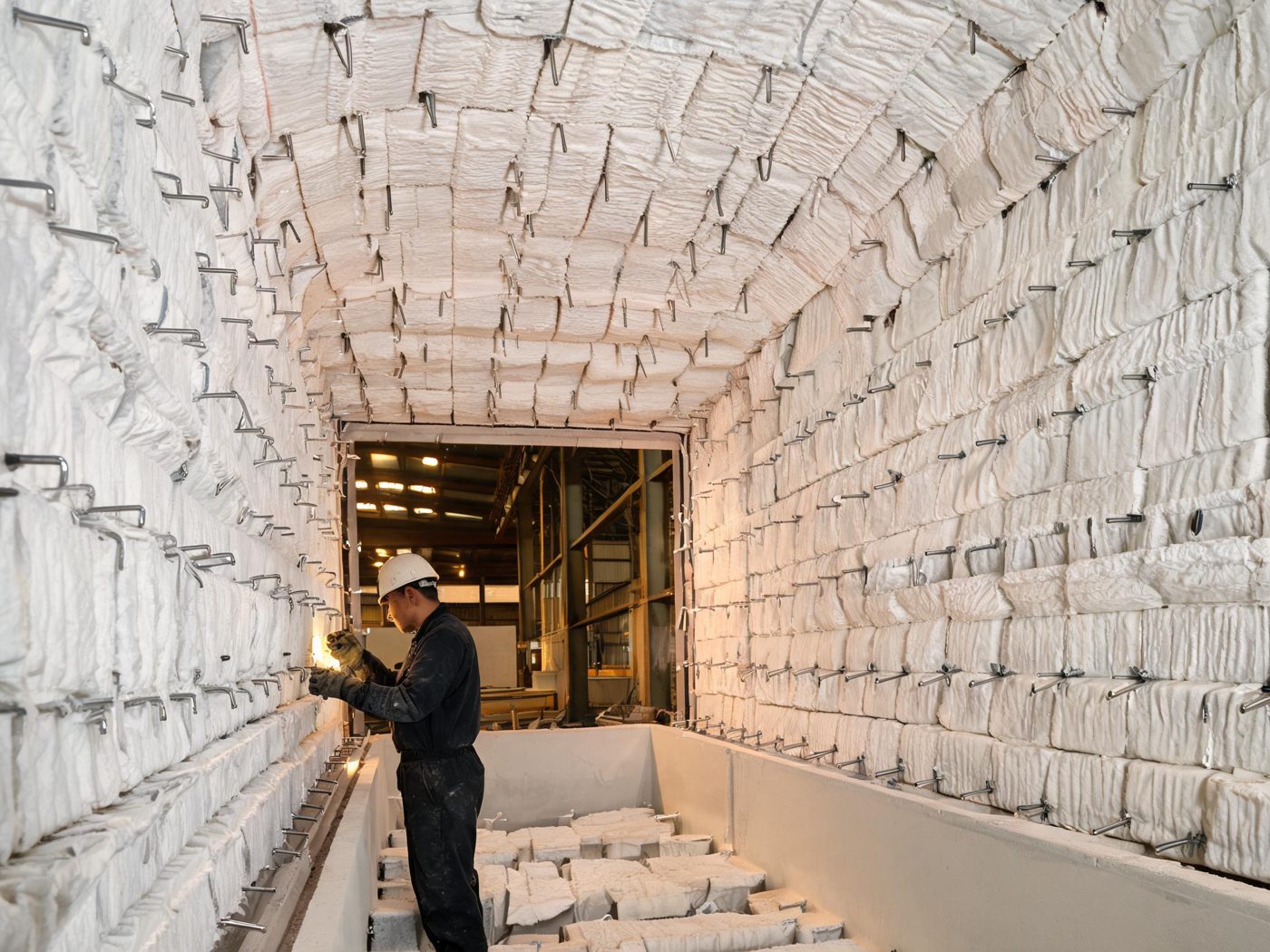
The idea of a module is to pre-compress needled blanket to a designed size, secure it with anchors, plates and strapping, then release it on site so the blanket springs back between the steel shell and the anchor. The result is a dense, gap-free lining. It is not "stacking blanket thicker"; pre-compression stores elastic energy, and the recovery force presses adjacent modules together to close shrinkage gaps at temperature.
A typical module consists of hot-face blanket layers, backup layers, anchors, a central plate or angle, and temporary strapping. Anchor material must match the furnace temperature—heat-resistant steel, 310S or ceramic anchors are common. The higher the temperature, the more important oxidation and creep resistance become. Many module failures are not caused by burned blanket but by anchors that oxidize and deform, allowing gaps to open and flame to reach the backup layers.
3.2 Pre-compression and resilience
Pre-compression is usually calculated from the difference between original and compressed thickness, with 15%–25% common in engineering practice. Too little compression leaves modules loose, and through-gaps appear after thermal shrinkage. Too much compression damages the fiber structure, reduces recovery force and can bend anchors during installation. The right value depends on blanket density, resilience and lining temperature—not on a single percentage copied from a drawing.
On site, check three details: whether the module recovers quickly after strapping is released, whether the corners remain full, and whether adjacent modules squeeze together naturally. Slow recovery and collapsed corners usually indicate insufficient needling or long storage.
3.3 Installation sequence and expansion joints
Installation usually starts from a corner of the wall or the center of the roof and proceeds according to the layout drawing, so that the last cut does not fall in an awkward corner. Anchors must be welded securely at the specified spacing. Modules are tapped tight with a mallet—never forced with a steel hammer. Burners, sight ports and thermocouple openings should be framed first, then cut, and the gaps packed with the same grade of blanket. Roof modules must also account for self-weight and thermal expansion; supports or hangers may be required.
4. Folded blocks: a "bendable module" for complex areas
A folded block is needled blanket folded repeatedly into an accordion shape and held by fasteners. Compared with a module, the fold direction can be adjusted on site, making it suitable for roofs, corners, burner surrounds and local repairs. Its flexibility conforms to curved or irregular shells, but it demands more consistent folding and fastener spacing.
| Item | Ceramic fiber module | Folded block |
|---|---|---|
| Structure | Pre-compressed blanket layers + plates + anchors | Accordion-folded blanket + fasteners |
| Best location | Large wall and roof areas | Corners, irregular areas, burners, repairs |
| Installation | Layout-driven and fast | Flexible, easy to adjust locally |
| Key control | Pre-compression, anchors, joints | Fold uniformity, fastener spacing, cut sealing |
| Common risk | Anchor oxidation, module collapse | Uneven folds, local over- or under-compression |
Choosing between them means choosing standardized layout or on-site adaptability. Regular furnaces, large areas and tight schedules favor modules; complex roofs, many openings and field adjustment favor folded blocks. They can be mixed: modules for the main area, folded blocks for corners and openings, provided joints are squeezed tight and packed with the same material.
5. Fiber board, paper and blanket: different jobs in the same family
5.1 Aluminosilicate fiber board: when you need strength and erosion resistance
Fiber board is made by vacuum filtration or wet forming, with density usually between 200 and 500 kg/m³ and thickness from 10 to 100 mm. It offers dimensional stability, compressive strength and resistance to gas erosion, making it suitable for load-bearing insulation pads, burner block backing, furnace door linings and mechanically fixed areas. Board generally has higher thermal conductivity than low-density blanket at the same temperature, so it should not simply replace blanket over a large insulation area, or the shell temperature may exceed design.
Key properties include compressive strength, linear shrinkage, density uniformity and clean cut surfaces. Use a fine-tooth saw or a dedicated cutter on site; cuts should be straight and produce minimal dust. Expansion joints between boards should be filled with fiber paper or loose wool as designed—never butted hard together.
5.2 Aluminosilicate fiber paper: thin, soft and sealing
Fiber paper is commonly 0.5–5 mm thick, flexible and easy to cut. It is used for thin insulation, gaskets, expansion-joint filling and separation between metal parts and refractories. Tensile strength is limited, and it should not be subjected to large-area mechanical abrasion. Strength drops after moisture pickup, so storage must be dry. Check thickness tolerance, density, loss on ignition and high-temperature shrinkage—especially for gaskets, where thickness variation directly affects sealing.
5.3 Aluminosilicate fiber blanket (insulation blanket): the workhorse for backup and pipes
Insulation blanket generally refers to low-density blanket for backup, pipes, tanks and kiln insulation, commonly 96–128 kg/m³. Its job is to keep heat inside, so thermal conductivity, resilience and conformity matter more than compressive strength. Multilayer insulation usually places lower density at the hot face and higher density toward the cold face, with staggered joints to reduce thermal bridges.
Pipe insulation must also handle elbows, valves and supports; kiln backup must account for expansion joints between the hot face and the blanket. Exposing insulation blanket directly to high-velocity gas or molten splashes usually leads to short life—a board or module hot face is needed for protection.
6. How to read performance data: classification temperature is not enough
Classification temperature is the starting point, not the whole story. Products with the same classification temperature can differ widely in shot content, resilience, tensile strength and thermal conductivity. The following indicators deserve attention in acceptance.
| Indicator | What it tells you | Typical reference | Acceptance advice |
|---|---|---|---|
| Classification temperature | Temperature grade, not long-term service limit | 1050 / 1260 / 1350 / 1430°C, etc. | Confirm against service temperature and atmosphere |
| Shot content | Unfiberized particles; affects feel and conductivity | Controlled by product grade | Request test report and compare by hand |
| Resilience | Recovery after compression; controls module joints | Depends on density and process | Compress a sample and observe recovery |
| Tensile strength | Interlayer bonding and handling reliability | Per product specification | Sample and compare by hand or tensile test |
| Linear shrinkage | Dimensional stability at temperature | Tested per classification temperature | Check test temperature and hold time |
| Thermal conductivity | Insulation capability, varies with temperature and density | Reported by temperature segment | Require test temperature and standard |
Important: classification temperature is not a long-term service temperature. Most aluminosilicate products should be used one grade below their classification temperature in continuous service, depending on atmosphere, load, allowable shrinkage and required life. Running a 1260°C blanket continuously at 1260°C often produces noticeable shrinkage and embrittlement—not because the product is fake, but because the design margin was insufficient.
7. The melting front and molybdenum electrodes: where fiber consistency begins
Whether the process is spinning or blowing, aluminosilicate wool starts as a pool of molten material in an electric furnace. Whether the melt temperature is stable, the composition uniform and contamination controlled directly affects fiber diameter distribution, shot content and color. A low melt temperature raises viscosity and tends to produce coarse fiber and shot; a high temperature increases energy consumption and may accelerate lining and electrode wear.
In a ceramic fiber resistance furnace, immersed molybdenum electrodes for ceramic fiber deliver stable electrical energy. Electrode purity, density and geometry determine current distribution and melt convection. An electrode that wears unevenly tilts the temperature field, and the fiberizing end produces "thick then thin" fluctuations. For plants making premium blanket, modules and export products, front-end electrode stability is often a better investment than one more needling pass.
If you are evaluating a melting furnace upgrade, also read rod versus plate electrodes for ceramic fiber furnaces and the guidance on molybdenum electrode current density, so electrode layout, power density and melt flow are considered together.
8. Selection path: work backward from the furnace condition
For a specific project, decide in this order:
- Set hot-face temperature and atmosphere. Long-term temperature, moisture, alkali vapor and reducing gases determine the grade and material class.
- Define load and erosion. Areas with high gas velocity, material abrasion or mechanical impact favor fiber board or high-density modules; pure backup insulation favors low-density blanket.
- Check the installation window. Tight schedules and regular geometry favor modules; many irregular areas and openings favor folded blocks or cut blanket.
- Confirm anchors and expansion. Anchor material, weld spacing and expansion-joint locations must be marked on the layout drawing.
Three common cases: glass furnace backup insulation usually uses multiple staggered layers of low-density blanket, with the hot face carried by brick or castable; the hot face of a ceramic fiber furnace often uses modules or folded blocks with blanket backup; pipes and tanks mainly use insulation blanket, with paper or loose wool at elbows and valves. Different cases produce different answers—a single "universal specification table" cannot cover them all.
9. Common misconceptions and field problems
- Price-only comparison ignores density. A lower-density blanket at the same thickness uses less material and costs less, but compresses permanently and insulates poorly over time.
- Classification temperature treated as service temperature. No safety margin leads to shrinkage and embrittlement, then a "quality complaint."
- Module joints not squeezed tight. Installation speed is prioritized, but without recovery force the joints open as soon as the lining shrinks.
- Anchor material mismatched to the blanket. Ordinary heat-resistant steel in a high-temperature zone oxidizes first, then the module collapses.
- Board and blanket mixed without thermal calculation. Replacing a load-bearing board with low-density blanket—or using board for large-area insulation—departs from the design.
FAQ
What is the difference between ceramic fiber needled blanket and ordinary fiber blanket?
Needled blanket is mechanically stitched with barbed needles, giving higher interlayer bonding, tensile strength and resilience. It is suitable as a module base and for load-bearing areas. Ordinary blanket without adequate needling delaminates more easily and is better for static backup. Ask for the number of needling passes and tensile data rather than judging by the name alone.
How do I choose between ceramic fiber modules and folded blocks?
For large, regular walls and roofs, modules offer faster layout-driven installation and more uniform joints. For corners, burner areas, irregular geometry and local repairs, folded blocks adapt better on site. The two can be combined, but joints must be tight and packed with the same grade of blanket.
Can a 1260°C blanket be used continuously at 1260°C?
Generally no. Classification temperature is a material grade, while continuous service must account for shrinkage, atmosphere, load and life margin—usually one grade lower. The actual limit should be based on the supplier's linear-shrinkage data and comparable case histories.
Where are fiber board, fiber paper and fiber blanket used?
Board is for load-bearing, erosion-resistant or mechanically fixed areas; paper is for thin insulation, gaskets and expansion joints; blanket is for large-area insulation, backup and module bases. They divide the work by load, thickness and installation method rather than replacing one another.
Does the quality of the molybdenum electrode affect the finished fiber product?
Yes. Electrode purity, density and wear affect the melt temperature field and impurity level, which in turn influence fiber diameter distribution, shot content and color consistency. For premium products, electrodes should be included in incoming-material and process control—not only the needling and cutting stages.
If you would like a recommendation based on your furnace type, temperature profile and existing lining photos, send the operating conditions to our team. We can propose a four-layer structure—hot face, backup, anchoring and expansion—and provide samples and supply options. You are also welcome to contact us directly.
Note: this article shares general industry and technical information and is not purchasing, investment or legal advice. Specific parameters and results are governed by the mutual technical agreement and factory inspection records.
Standards note: electrodes are controlled to YS/T 1312-2019 Molybdenum Electrodes; molybdenum rods to ASTM B387 / GB/T 17792; molybdenum plate and discs to ASTM B386 / GB/T 3876. Parameter ranges in this article summarise public technical data and engineering practice — actual values vary with furnace conditions and are governed by the technical agreement and inspection records.
Related products
Electrodes and high-temperature molybdenum parts for this duty — specifications and selection notes are on the product pages.
Product information

Molybdenum needle
High-temperature needles for clearing glass and aluminosilicate fiber furnace flow channels, plus slim needles for electrostatic precipitation and ion generation.
View specifications →
Ceramic fiber and refractory molybdenum electrode
For electric melting and fiberizing in ceramic fiber, rock wool and refractory fiber resistance furnaces; high-temperature erosion resistance for continuous production.
View specifications →
Molybdenum threaded rod
M3–M30 high-temperature molybdenum fasteners in hex, socket, slotted and T-head forms, with molybdenum nuts and washers for vacuum furnace hot zones.
View specifications →