Spinning vs Blowing for Aluminosilicate Ceramic Fiber: Fiber Formation, Morphology and Selection
WeiBeam · Electrode solutions for high-temperature melting
Spinning and blowing differ in fiberizing force, not chemistry. Compare fiber diameter, length, shot content, classification temperature, equipment and selection, and see why molybdenum electrodes in the electric melter matter.
The short answer. Spinning and blowing of aluminosilicate ceramic fiber differ not in formulation but in the force used to draw the melt into fibers. Spinning uses a multi-stage high-speed centrifugal rotor to throw and attenuate the melt stream: fibers are coarser, longer, lower in shot content and stronger, which suits needled blankets, textiles and load-bearing packing. Blowing uses compressed air or superheated steam to break up, atomize and attenuate the stream: fibers are finer, shorter and softer, with slightly lower thermal conductivity, which suits fiber paper, spray coatings, castables and backing insulation. Both routes depend on an electric melting furnace to deliver a homogeneous, low-viscosity, temperature-stable melt, and the stability and purity of that melt depend heavily on the immersed molybdenum electrodes.
This article follows the sequence fiber-forming force, equipment and parameters, fiber morphology, quality metrics, melting front end, failure mechanisms and selection path. The figures are typical ranges from public engineering sources; actual purchasing should be based on supplier test data and site conditions.
1. The dividing line: what force does each process borrow?
Fiber formation is essentially the rapid stretching, cooling and solidification of a high-temperature, low-viscosity silicate melt stream. Where the stretching force comes from determines fiber diameter, length and morphology. Blowing borrows the shear and drag of a high-speed gas stream; spinning borrows the centrifugal force of high-speed rotor surfaces and the speed differential between rotors. One uses "wind", the other "throws", and every subsequent difference follows from that.
This also explains a common misunderstanding: some assume the two processes produce different chemical compositions. In fact, with the same formulation the chemical composition is essentially identical; the differences lie mainly in fiber morphology, that is diameter, length and shot content, and in production scale. Composition is set by the raw-material grade (standard, high-purity, high-alumina or zirconia-containing) and has little to do with the fiberizing method.
2. Blowing: blowing the melt into fiber with a high-speed gas stream
2.1 Process principle
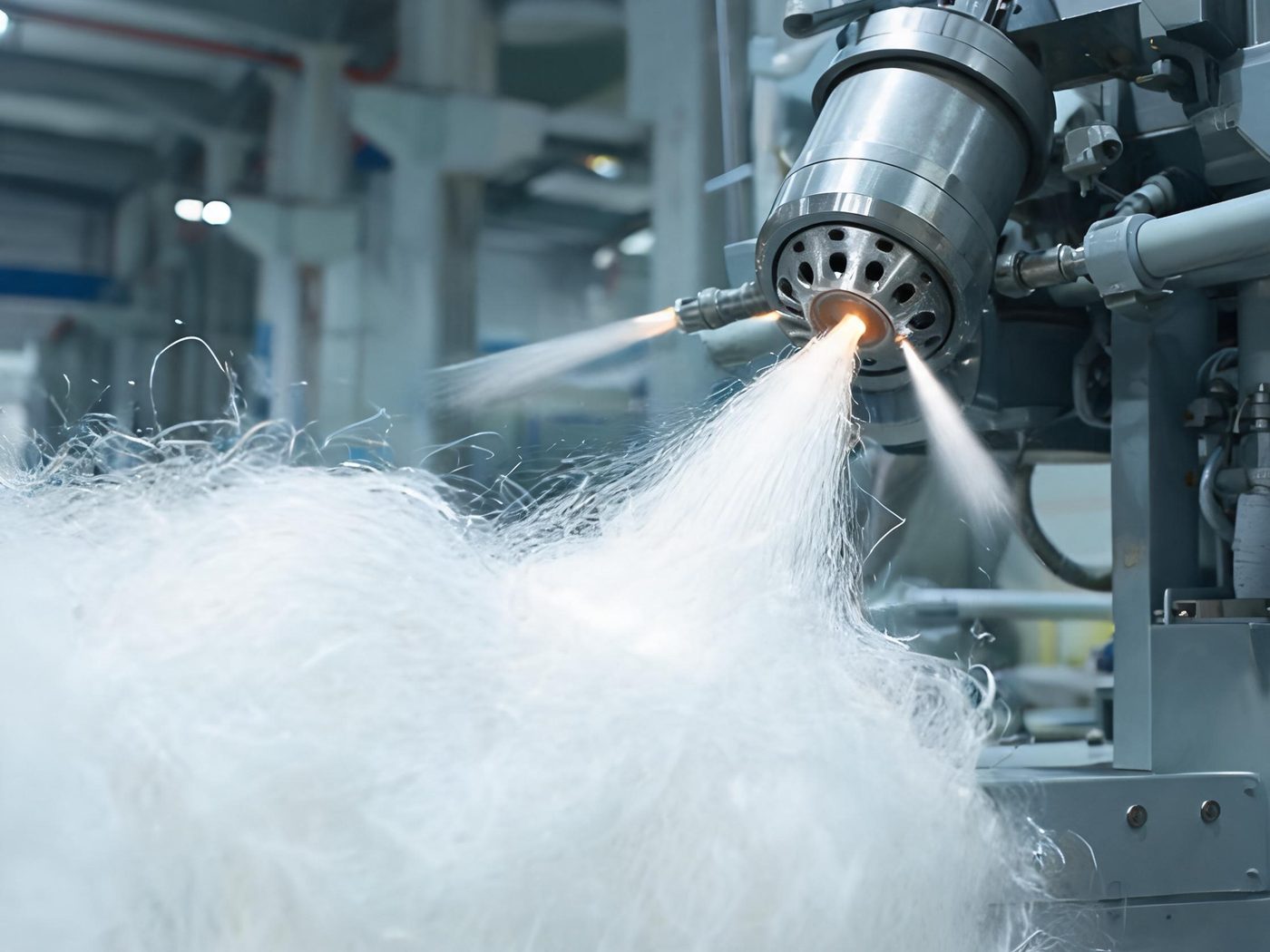
In blowing, the melt stream leaving the forehearth is struck by high-speed compressed air or superheated steam from a nozzle. The gas first breaks the continuous stream into fine droplets and then attenuates the droplets into fibers as they are dragged along, followed by cooling. Public engineering sources cite a typical blowing pressure of about 0.6–0.8 MPa. The driving force comes entirely from the gas, and the equipment configuration is relatively simple.
2.2 Equipment and production characteristics
- Simple equipment, low maintenance and easy operation, with relatively light initial investment and repair burden.
- Low output per unit, usually suitable for small and medium lines below 500 t per year.
- Finer fibers, typically 2–3 μm average diameter, with good softness, fine porosity and slightly better thermal conductivity.
- Shorter fibers, mostly below 50 mm, with relatively higher shot content and lower tensile strength than spun fiber.
Because the fibers are fine, short, soft and finely porous, blown wool is better suited to vacuum-formed shapes, spray coatings, castables, fiber paper and lightly loaded backing insulation. These applications value filling and insulation rather than fiber length and tensile strength.

3. Spinning: throwing the melt into fiber with centrifugal force
3.1 Process principle
In spinning, the melt stream falls onto the surface of a high-speed rotating centrifugal rotor and is dispersed by centrifugal force, then attenuated into fiber by two or three successive rotors running at increasing speed. A common three-rotor arrangement uses a distributing rotor of about 100–200 mm diameter at a surface speed of about 20–30 m/s; the accelerating rotors are about 1.5–3 times the distributing-rotor diameter, with the first stage at about 70–110 m/s and the second at about 85–135 m/s. Spinning rotors are usually made of hardened stainless steel and are equipped with forced water cooling and oil-mist lubrication.
3.2 Equipment and production characteristics
- Complex equipment with variable-frequency drives, oil-mist lubrication and forced water cooling; maintenance, operating difficulty and power consumption are all higher.
- High output per unit and high fiberization efficiency, usually suitable for large refractory-fiber lines of around 1000 t per year.
- Coarser fibers, typically 3–5 μm average diameter, but lengths can reach the order of 200 mm. Strength is high, and the fibers entangle to give good tensile performance.
- Low shot content and consistent fiber quality, making spun fiber the mainstream choice for needled blankets, textiles and high-temperature furnace packing.
The long, strong fibers of spun wool make it more resistant to flexing, breakage and dusting in equipment gaps subject to mechanical vibration and in folded modules that must carry load. This is why large ceramic-fiber blanket lines generally use spinning.
4. Comparison of core metrics: fiber diameter, shot and classification temperature
Placing the two processes in one table makes the differences easier to see. The values are typical ranges from public product data and industry references; they vary with supplier and formulation and should be confirmed against supplier test data.
| Comparison | Blowing | Spinning |
|---|---|---|
| Fiberizing force | High-speed compressed air or steam, about 0.6–0.8 MPa | Centrifugal force of multi-stage rotors, surface speeds up to the order of 135 m/s |
| Average fiber diameter | Finer, about 2–3 μm | Coarser, about 3–5 μm |
| Fiber length | Shorter, mostly < 50 mm | Longer, up to the order of 200 mm |
| Shot content | Relatively high | Relatively low |
| Softness / thermal conductivity | Softer, finer pores, slightly better insulation | Higher strength, better tensile behavior, good windability |
| Output per unit | Lower; suits small and medium lines < 500 t/a | Higher; suits large lines > 1000 t/a |
| Equipment and maintenance | Simple, low maintenance, low investment | Complex, higher maintenance, higher power consumption |
| Typical products | Fiber paper, spray coatings, castables, vacuum-formed shapes, backing | Needled blanket, textiles, folded modules, load-bearing packing |
4.1 About shot content
Shot consists of granular melt particles that were not drawn into fiber. It is an important indicator that affects insulation performance and uniformity. Public data commonly show 3%–4% shot in standard aluminosilicate refractory fiber, while some products are marked at ≤15% using a screening threshold of φ ≥ 0.25 mm. Spinning gives a higher fiberization rate and more complete attenuation, so shot is usually lower; blowing tends to leave more shot. Where thermal performance and uniformity matter, specify the shot limit in the technical agreement and define the screening method, so that a supplier cannot look better simply by using a different test threshold.
4.2 About classification temperature and service temperature
Classification temperature is the limiting temperature a fiber can withstand under specified conditions, usually 24 hours with shrinkage below a defined threshold. Common grades are 1260, 1350, 1400, 1430 and 1600 °C. It is not the same as long-term service temperature. Standard aluminosilicate fiber, for example, has a classification temperature of 1260 °C but a long-term service temperature of about 1000 °C. Select against the actual working temperature, not the classification temperature, and keep a safety margin.
- Standard grade: Al₂O₃ about 42%–46%, classification temperature about 1100–1260 °C, long-term use ≤1000 °C.
- High-purity / high-alumina grade: Al₂O₃ about 47%–55%, classification temperature about 1260–1360 °C and a higher long-term service temperature.
- Zirconia-containing grade: about 15%–17% ZrO₂, classification temperature up to 1430 °C, with better corrosion resistance and high-temperature stability.
- Polycrystalline mullite / alumina fiber: Al₂O₃ up to 72% or more, classification temperature around 1600 °C, a premium high-temperature fiber.
5. The melting front end: the role of the electric furnace and molybdenum electrodes
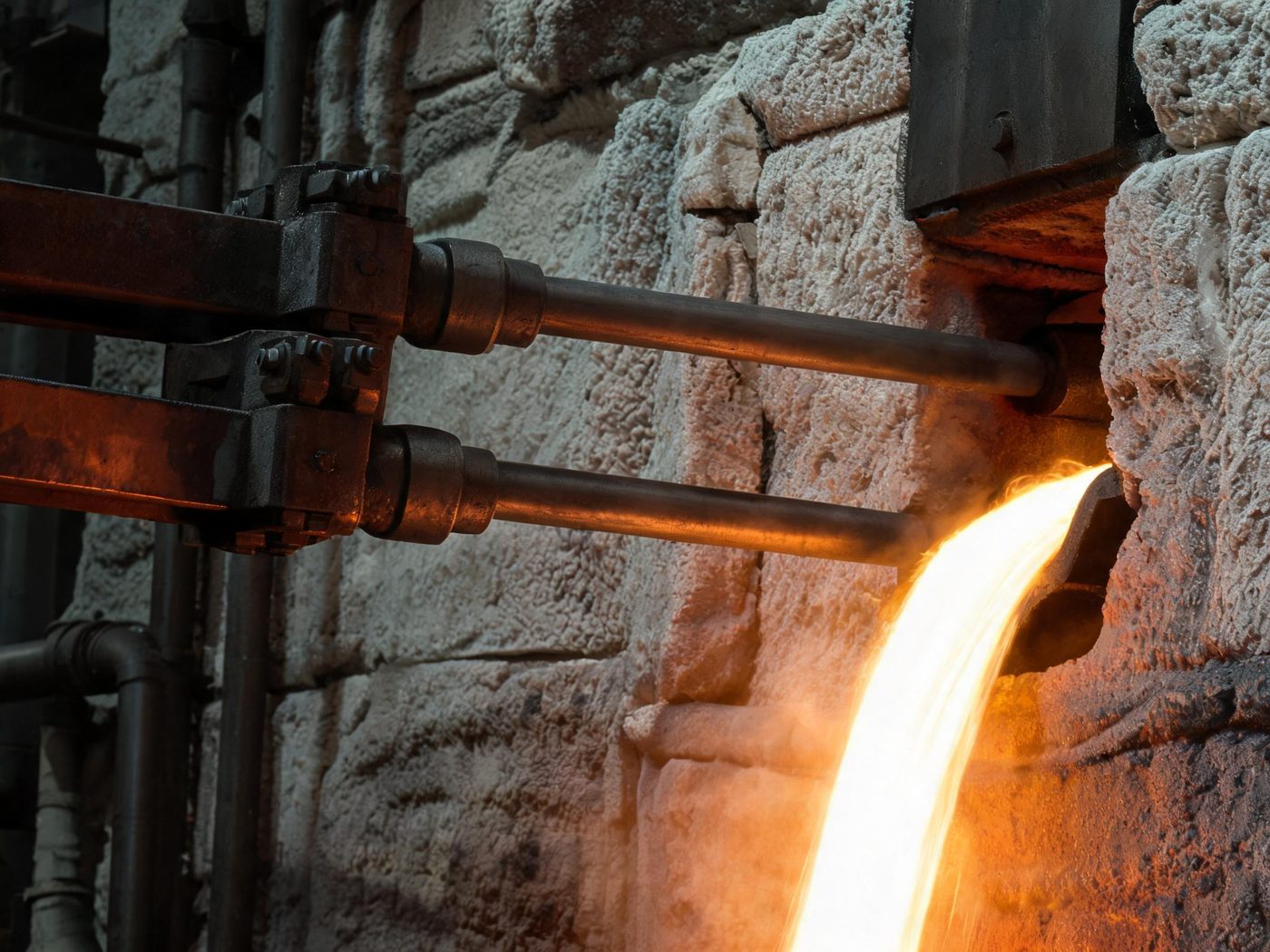
Whether the route is spinning or blowing, the prerequisite is a homogeneous, low-viscosity, temperature-stable melt. This is usually produced in a resistance-heated electric melting furnace, where raw materials melt above about 2000 °C and electrical energy is introduced through electrodes to heat the melt by Joule heating. Compared with a flame-fired tank furnace, an electric melter offers a stable temperature field, high thermal efficiency and low iron pickup in the melt, which better meets the uniformity requirements of spinning. This is an important reason why ceramic-fiber melting has been shifting from flame furnaces to electric melting in recent years.
In this high-temperature aluminosilicate melt, the molybdenum electrode is the critical conductive component. It must operate continuously above 1600 °C, resist attack by the aluminosilicate melt and avoid introducing iron or other coloring impurities into the fiber, since impurity content directly affects fiber color and temperature resistance. Public engineering data give a typical order of magnitude of about 3000–4000 kWh of electricity per tonne of fiber and about 2 kg of molybdenum electrode consumption per tonne. This is why electrode purity, density and a sensible current density directly affect fiberizing stability and the electrode replacement interval.
Seen end to end, spinning and blowing determine how the melt becomes fiber, while the electric melter and its electrodes determine whether the melt itself is stable and clean. The former is the forming process; the latter is the melting basis. Together they set final fiber quality and cost. For the electrode shapes and layouts commonly used in ceramic-fiber electric melters, see rod versus plate electrodes in ceramic-fiber electric furnaces. For matching electrode specification to melt resistivity, see the molybdenum electrodes for ceramic fiber furnaces product page.
6. High-temperature failure: crystallization and shrinkage are not fiberizing defects
Many readers confuse fiber dusting and shrinkage with the spinning or blowing process. They are problems at different stages. Crystallization is the failure mechanism of aluminosilicate fiber during long-term high-temperature service and has little to do with how the fiber was formed. Standard aluminosilicate fiber is a supercooled glass; on heating it transforms toward stable crystalline phases. Mullite begins to precipitate at about 900 °C, cristobalite appears near 1100 °C, and at 1260 °C both precipitate heavily. The fiber structure is destroyed, which shows up as heat shrinkage, loss of resilience and, in severe cases, dusting and spalling.
| Temperature range | Structural change | Macroscopic effect |
|---|---|---|
| 800–900 °C | Glass softens and creeps; initial shrinkage | Slight dimensional change, reduced resilience |
| 930–960 °C | Mullite microcrystals precipitate and form a skeleton | Shrinkage stabilizes; strength changes slightly |
| Approaching 1100–1260 °C | Abundant cristobalite precipitation; fiber loses its characteristic structure | Marked shrinkage and dusting; insulation performance falls |
This also explains why zirconia-containing, high-alumina and polycrystalline mullite fibers raise Al₂O₃ and add ZrO₂ to suppress crystallization and raise service temperature. That is a matter of chemistry and formulation, not something spinning or blowing can solve. If the duty is long-term above 1000 °C, upgrade the fiber grade rather than debating the fiberizing process.
7. How to select by duty: a practical decision path
| Your duty | Prefer | Reason |
|---|---|---|
| High load or vibration, tensile strength needed (modules, folded blocks) | Spun wool | Long fibers, high strength, flex resistance, low shot |
| Backing insulation, light load, low thermal conductivity | Blown wool | Fine fibers, fine pores, soft, slightly better insulation |
| Fiber paper, spray coatings, vacuum-formed shapes | Blown wool | Short fine fibers suit wet and spray forming |
| Needled blanket, textiles and similar mainstream products | Spun wool | Long, well-entangled fiber is the main needled-blanket feedstock |
| Large continuous line (1000 t/a class) | Spinning | High output per unit, high fiberization, better unit cost |
| Small or medium batches, many grades, limited investment | Blowing | Simple equipment, low maintenance, flexible changeover |
In a purchasing conversation, clarify four points: the application and mechanical load, which decide spinning or blowing; the working temperature and atmosphere, which decide grade and classification temperature and require a safety margin; the shot content and screening method, which should be written into the technical agreement; and supply stability plus test reports. These four points matter more than price alone if the fiber is to last in service.
8. Conclusion
- The difference between spinning and blowing of aluminosilicate ceramic fiber comes down to the fiberizing force: centrifugal rotor force for spinning, high-speed gas impact for blowing.
- Spun fiber is coarser and longer (about 3–5 μm, up to 200 mm), with low shot, high strength and high output; it dominates needled blankets and load-bearing packing. Blown fiber is finer and shorter (about 2–3 μm, <50 mm), with more shot but greater softness and slightly better insulation; it suits ultra-fine products and backing.
- Classification temperature is not service temperature: standard aluminosilicate fiber should be used below 1000 °C long term, and high-temperature duties require zirconia-containing or polycrystalline mullite grades.
- Crystallization and shrinkage are high-temperature service failure mechanisms, with mullite precipitating from about 900 °C and cristobalite from about 1100 °C. They are unrelated to the fiberizing process and must be separated from it during selection.
- The electric melter and electrodes at the front end determine melt stability and purity and, together with the fiberizing process, determine fiber quality and cost. Selection should weigh load, temperature, shot and supply as four dimensions.
FAQ
Is spun wool better than blown wool?
Neither is universally better; it depends on the application. Spun wool is more durable in loaded, vibrating packing and folded modules. Blown wool is more suitable for lightly loaded backing, lower thermal conductivity or fiber paper and spray coatings. Define the duty before choosing the process.
Do spinning and blowing produce fiber with the same chemical composition?
With the same formulation the chemical composition is essentially the same. The difference is mainly fiber morphology, that is diameter, length and shot, rather than chemistry. Composition is set by raw-material grade (standard, high-purity, high-alumina or zirconia-containing) and is unrelated to the fiberizing method.
What happens if shot content is high?
Shot reduces fiber uniformity and insulation efficiency and can create hot spots or hard points in finished products. Where thermal performance and appearance matter, set an upper shot limit and standardize the screening method, for example φ ≥ 0.25 mm or >212 μm.
Does a classification temperature of 1400 °C mean the fiber can serve at 1400 °C long term?
No. Classification temperature is a short-term limit; long-term service temperature is usually 200–400 °C lower. Standard 1260 °C fiber serves at about 1000 °C long term. High-temperature duties require high-alumina, zirconia-containing or polycrystalline fiber with a safety margin.
Why do ceramic-fiber electric melters use molybdenum electrodes?
The aluminosilicate melt is above 1600 °C and must stay low in iron and contamination. Molybdenum has a high melting point, is chemically inert toward the aluminosilicate melt and conducts stably at high temperature, so it can work in this environment for long periods. Typical electricity consumption is about 3000–4000 kWh per tonne of fiber, with about 2 kg of molybdenum electrode consumed per tonne.
References and basis
The key data in this article, including blowing pressure, spinning-rotor surface speed, fiber diameter and length ranges, shot content, classification and crystallization temperatures, energy consumption and electrode consumption, are typical ranges drawn from public industry references, product technical data and testing-laboratory explanations. They illustrate process differences and orders of magnitude and are not a specification commitment by any supplier. Actual selection should follow supplier test data and site conditions. To review electrode configuration against a specific furnace duty, contact us.
Note: this article shares general industry and technical information and is not purchasing, investment or legal advice. Specific parameters and results are governed by the mutual technical agreement and factory inspection records.
Standards note: electrodes are controlled to YS/T 1312-2019 Molybdenum Electrodes; molybdenum rods to ASTM B387 / GB/T 17792; molybdenum plate and discs to ASTM B386 / GB/T 3876. Parameter ranges in this article summarise public technical data and engineering practice — actual values vary with furnace conditions and are governed by the technical agreement and inspection records.
Related products
Electrodes and high-temperature molybdenum parts for this duty — specifications and selection notes are on the product pages.
Product information

Ceramic fiber and refractory molybdenum electrode
For electric melting and fiberizing in ceramic fiber, rock wool and refractory fiber resistance furnaces; high-temperature erosion resistance for continuous production.
View specifications →
Molybdenum needle
High-temperature needles for clearing glass and aluminosilicate fiber furnace flow channels, plus slim needles for electrostatic precipitation and ion generation.
View specifications →
Molybdenum stream mouth
Discharge nozzle at the end of fiberglass and aluminosilicate fiber forehearths; water-cooled or water-free oxidation protection, high-temperature and anti-clogging, custom to furnace drawings.
View specifications →