Effect of Forging Ratio on the Structure and Density of Molybdenum Electrodes
WeiBeam · Electrode solutions for high-temperature melting
Forging ratio determines whether residual porosity in the sintered billet can be welded shut and whether columnar porosity can be broken up. Too little deformation leaves both density and toughness low, while too much raises equipment cost and introduces anisotropy. This article explains the mechanism by which forging ratio affects density and gives engineering experience on coordinated control of temperature and deformation.
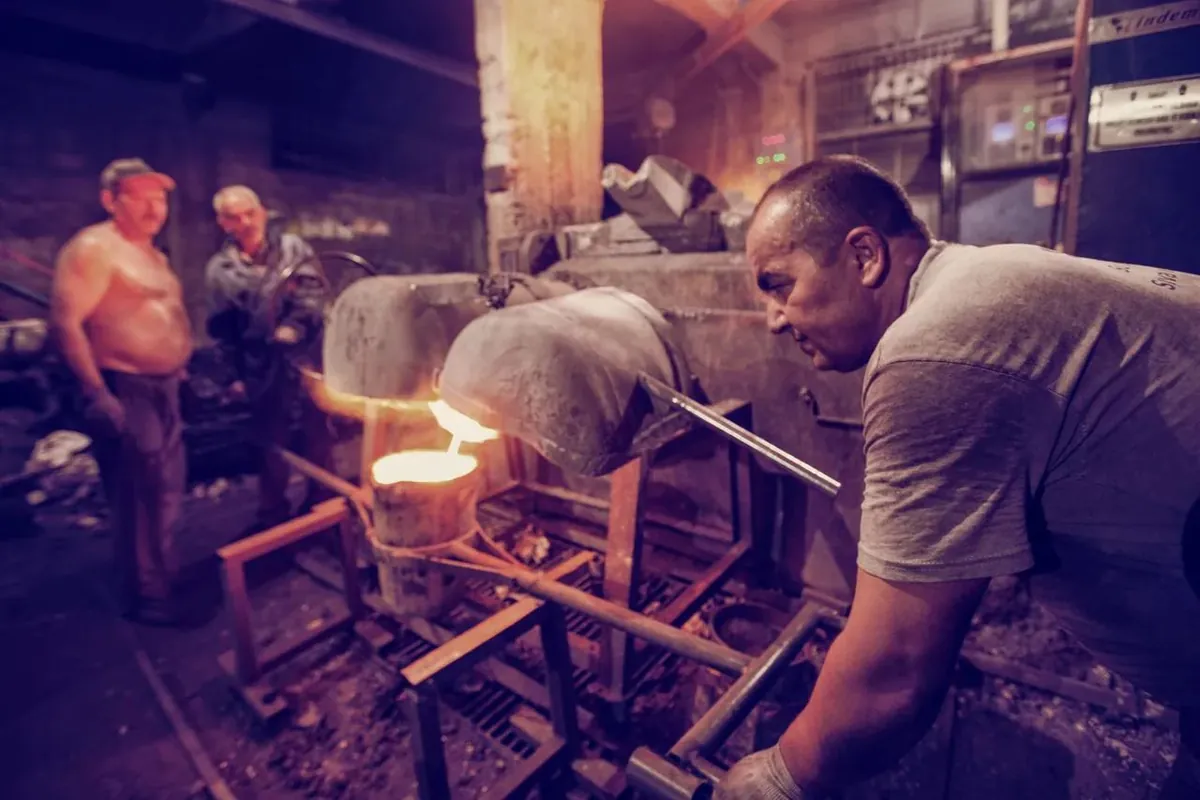
Forging is not simply hammering a billet into a bar: whether the deformation is sufficient determines whether the pores inside the sintered body are welded shut or retained. Forging ratio is therefore the core variable in the quality of molybdenum electrode billets and one of the key steps that separates one manufacturer's product from another. The forging ratio is the scale that turns a sintered part into a forged part, and any shortfall will eventually be exposed as a porous band or edge cracks.
Mechanism: Pore Closure Requires Sufficient Triaxial Compressive Strain
The relative density of sintered molybdenum is usually around 90%, with residual interconnected porosity and microcracks inside. During forging the material is compressed and extended, and pores are flattened and welded shut under compressive and hydrostatic stress. If the total deformation is insufficient, the strain in the central region does not reach the closure threshold, porosity remains in the bar core, showing up as bottom-echo attenuation in ultrasonic testing and acting in service as a crack source and an erosion channel. Experience shows that larger-section billets need a higher forging ratio, because central strain decays as the section grows: the same press can easily meet the target on small bars and easily fall short on large ones. Once a bar with unclosed porosity is charged into the furnace, the central porosity forms a pitted surface under erosion, and this becomes the starting point of premature scrapping and the place where the lower limit of molybdenum electrode life fails.
Coordination of Temperature and Deformation
The coordination of temperature and deformation can be summarized in a few rules: forging temperature is generally controlled in the range of about 1100-1400 °C, since too low a temperature cracks edges while too high a temperature coarsens grains and makes the billet stick to the die; reduction per pass is distributed progressively to avoid excessive strain difference between surface and core; in direction, upsetting, drawing and turning are combined so that triaxial strain acts fully on the core; after finish forging, recrystallization annealing or further processing is scheduled according to grade to control final grain size and make the structural origin of the molybdenum electrode traceable; deformation is not better the larger it is, since excess working raises cost, elongates grains and lowers transverse properties; for large-section billets, an upsetting-and-drawing combined route is preferred, using direction exchange to deliver strain to the core. Process details such as cooling tower unit acceptance criteria are systematically described in the electrode manufacturing process.
Forging quality is evidenced by three sets of data: Archimedes density reaching the target value of about 10.2 g/cm³; longitudinal-wave ultrasonic testing with no reflections above the limit; and a macro acid-etched specimen showing welded pores and no residual porosity. All three indicators must be retained with samples and traces on file for customer re-inspection and later traceability, as the written basis for releasing an electrode. WeiBeam.com treats these three as the release conditions for forged billets, because they are closely related to the thermal shock resistance, erosion uniformity and batch-to-batch life stability of the electrode, and any failure in one of them will be amplified in service. The finish-forging temperature and slow cooling rate also affect the recrystallized state and must be specified together with the subsequent annealing schedule. A suitable forging ratio is the balance point at which the billet is worked to density without being worked to damage.
| Indicator | Reference note |
|---|---|
| Common specifications | Rod diameter Φ20-100 mm, length 150-1500 mm (custom-made to drawing) |
| Applicable standards | YS/T 1312-2019 Molybdenum Electrodes; molybdenum rods follow ASTM B387 / GB/T 17792, molybdenum plate and disc follow ASTM B386 / GB/T 3876 |
| Working current density | 1-3 A/cm² |
| Quality documentation | Factory inspection covers composition, density, metallurgy, ultrasonic testing and dimensional tolerances; a quality certificate accompanies each shipment and batches are traceable |
| Working temperature | About 1300 °C long-term, short-term limit about 1600 °C |
Frequently asked questions
How are the acceptance indicators for molybdenum electrodes checked?
All three indicators must be retained with samples and traces on file for customer re-inspection and later traceability, as the written basis for releasing an electrode. A macro acid-etched specimen shows welded pores and no residual porosity.
What does the coordination of temperature and deformation cover?
It can be summarized in a few rules: forging temperature is generally controlled in the range of about 1100-1400 °C; too low a temperature cracks edges, while too high a temperature coarsens grains and makes the billet stick to the die. Deformation is not better the larger it is, since excess working raises cost, elongates grains and lowers transverse properties.
Note: this article shares general industry and technical information and is not purchasing, investment or legal advice. Specific parameters and results are governed by the mutual technical agreement and factory inspection records.
Standards note: electrodes are controlled to YS/T 1312-2019 Molybdenum Electrodes; molybdenum rods to ASTM B387 / GB/T 17792; molybdenum plate and discs to ASTM B386 / GB/T 3876. Parameter ranges in this article summarise public technical data and engineering practice — actual values vary with furnace conditions and are governed by the technical agreement and inspection records.
Related products
Electrodes and high-temperature molybdenum parts for this duty — specifications and selection notes are on the product pages.
Product information

Molybdenum disc
Circular sheet made from high-purity molybdenum powder by powder metallurgy and rolling; used for furnace heating elements, heat shields, boats and sputtering targets.
View specifications →
Molybdenum rod and shaft
Rod and shaft diameters beyond wire: Ø0.5–25mm drawn or swaged shafts and Ø16–300mm forged or sintered rods, for vacuum electronics, guide rods, electrodes and heating elements.
View specifications →
Glass melting furnace molybdenum electrode
For electric boosting and all-electric melting of container, packaging, pharmaceutical, photovoltaic and electronic glass, compatible with mainstream refractories and furnace designs.
View specifications →